
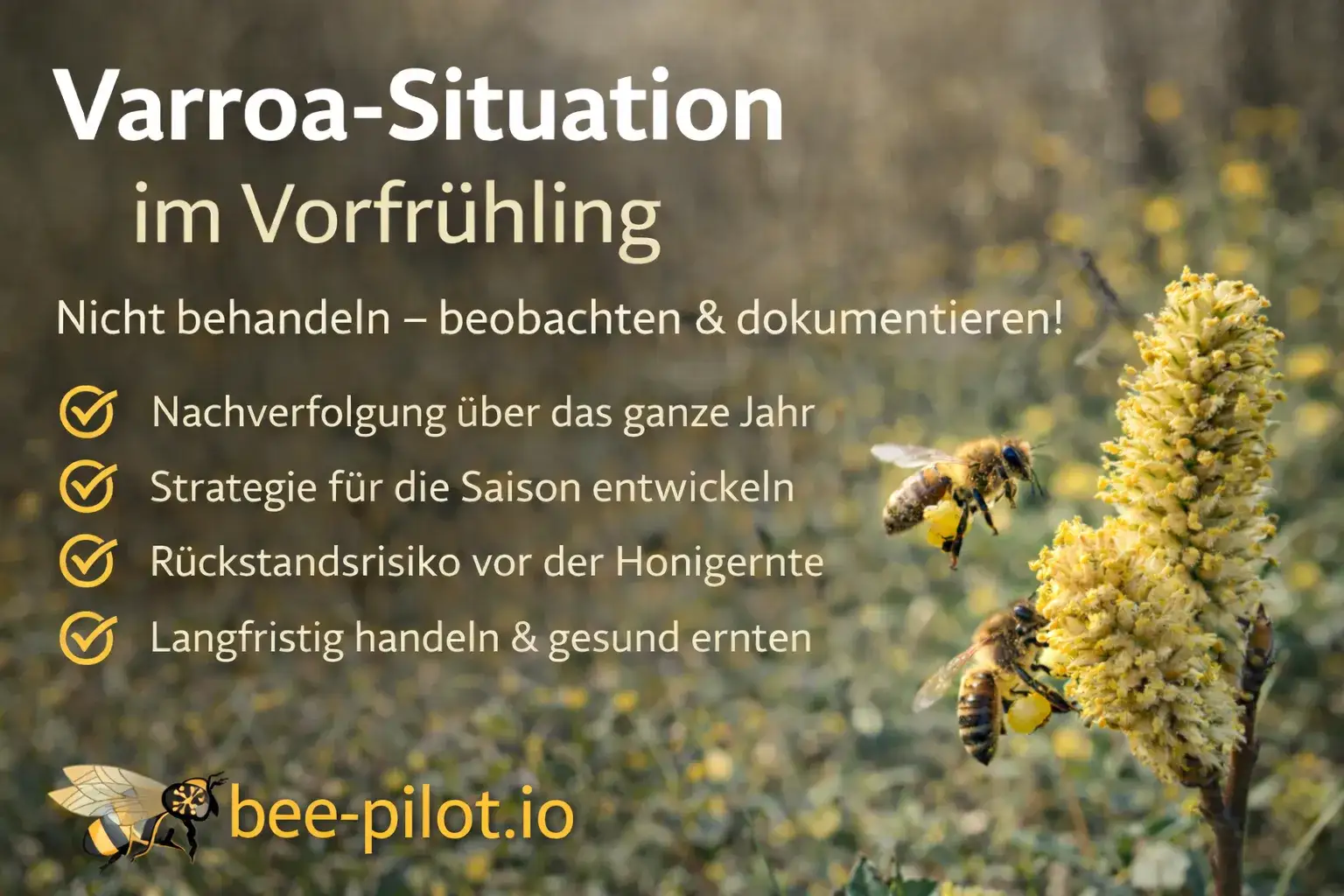
Varroa Management
Evaluate Objectively and Act Strategically.
At the end of winter, many beekeepers face a central question: What is the Varroa load of my colonies at the start of the season?
Especially in early spring, a clear assessment is crucial. Individual observations or momentary values often lead to misinterpretations.
Development in Early Spring
With increasing brood area, the bee population in spring initially grows significantly faster than the mite population.
This temporarily improves the relative ratio of bees to Varroa mites in favor of the colony. The burden per bee initially decreases, although the absolute number of mites does not necessarily decrease.
However, this effect should not be mistaken for a green light: Once brood dynamics stabilize and expand, the Varroa reproduction rate significantly increases. Spring development largely determines the summer burden.
No Treatment Before Honey Harvest
If honey is to be harvested from a colony in the current year, treatments after January 1 are generally critically assessed.
Few approved products and methods exist, yet every application in the harvest year carries risks concerning residues, honey quality, and marketability.
For product safety reasons, we – especially for beginners – strongly advise against treatments before the honey harvest. Consistent winter treatment and a clearly structured summer plan are the safe long-term approach.
Systematically Evaluate Varroa Levels
A successful season depends not on a single measurement but on the continuous assessment of Varroa development throughout the year.
Key points include:
- Documentation of natural mite drop
- Evaluation over time
- Contextualization in relation to brood development
- Comparison between own locations
Only when this data is included in annual planning can treatment times be strategically rather than reactively set.
Our app bee-pilot.io enables structured recording and evaluation of Varroa values per location. This turns individual observations into a reliable decision-making basis for the entire beekeeping year.
Conclusion
Early spring is not a treatment phase but an observation and analysis phase.
Those who document systematically now lay the foundation for healthy colonies, planned interventions, and high-quality honey in the further course of the season.
Try bee-pilot.io now