Zucht & Betriebsentwicklung
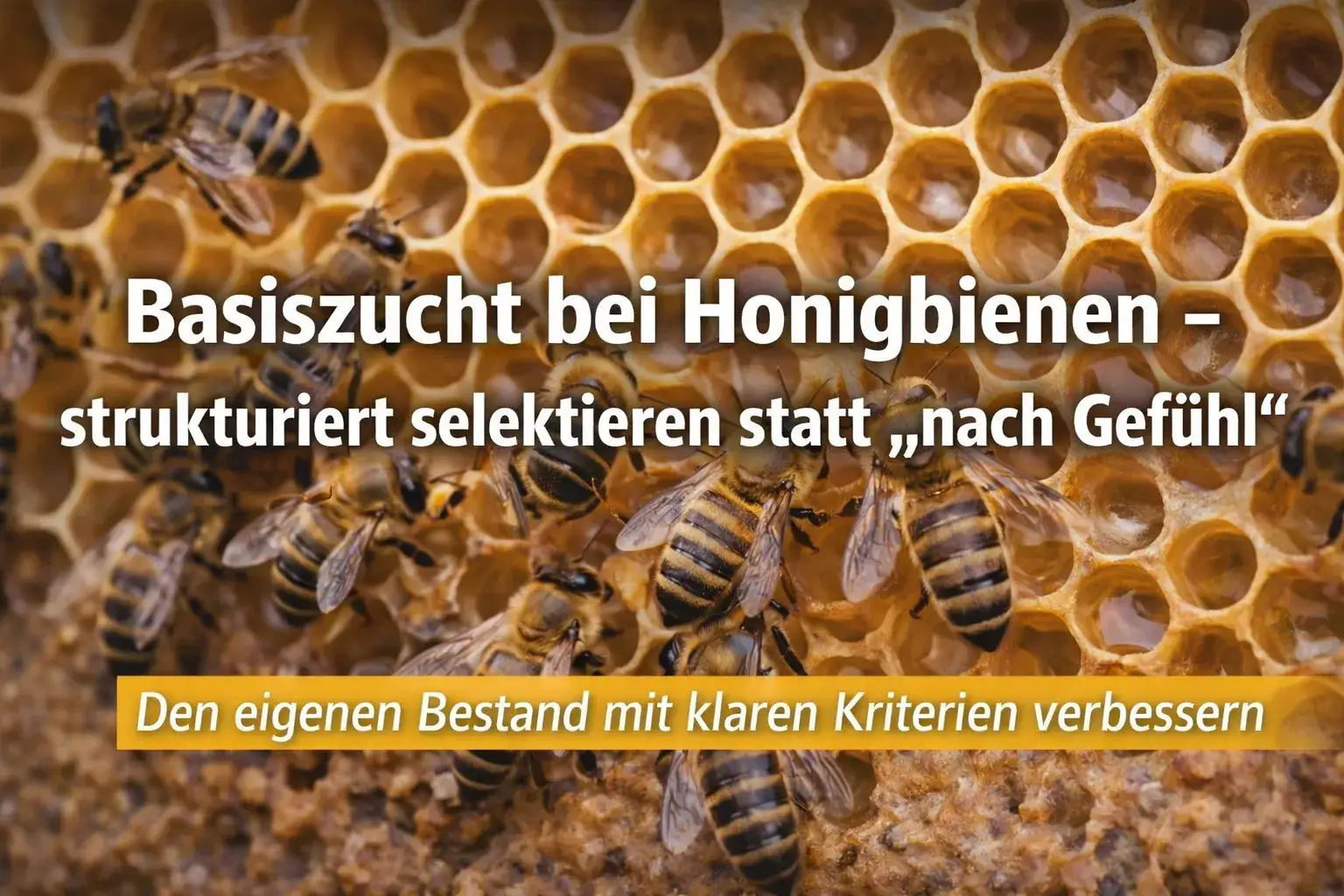
Basic Breeding in Honey Bees – Structured Selection Instead of “Gut Feeling”
Improve your stock sustainably with clear criteria, consistent selection, and digital documentation.
Basic breeding is a simple and effective way to improve your bee stock step by step—not through random success, but through consistent selection. The core idea is to observe and evaluate the colonies according to fixed criteria throughout the season to make reliable decisions at the end.
It’s not the impression from a single inspection that counts, but the sum of observations under different conditions: spring development, behavior during nectar flow, swarming tendency, health, and overwintering performance. Many decisions in practice fail here as they are too influenced by the moment.
Why “Gut Feeling” Decisions Often Mislead
Be honest: who hasn’t propagated from a queen because she seemed “really good”—calm, strong, with a nice brood pattern—only to find out later that she wasn’t a good choice throughout the season or the following year? Such misjudgments are normal since performance and behavior are greatly influenced by weather, nectar flow, location, management practices, queen’s age, and mating.
Basic breeding counters this with a simple but effective principle: do not decide by gut feeling, but by comparable criteria that are regularly and uniformly recorded.
Multiple Outstanding Queens Instead of “The Best One”
A central approach in basic breeding is not to rely on a single queen. Instead of making “the best one” the mother for everything, it is more stable and breeding-wise sensible to propagate from several queens—ideally from the top third of your stock.
This spreads the genetic risk, keeping the progress in the stock more stable and traceable in the long term.
The Decisive Lever: Replacing the Bottom Third
Even more important for genuine progress is the consistency downward: the worst third of queens or colonies should be replaced every year. Not just at any time, but as a fixed part of the system. This consistent replacement continually removes undesirable traits from the stock and prevents weak lines from slowing down development.
Making Breeding Goals Visible and Comparable
Basic breeding becomes particularly valuable when your breeding goal is clearly depicted. Not every beekeeper prioritizes the same: for some, gentleness and comb adherence come first, for others swarm resistance and winter hardiness, while others may prefer to emphasize honey production or consider Varroa-related measurements.
Digital documentation systems like bee-pilot.io aid in structuring evaluations, weighting criteria, and creating transparent rankings. This transforms many individual observations into a comprehensible overall assessment, on which breeding decisions can be made more confidently and reproducibly.
Conclusion
Basic breeding succeeds when implemented as a fixed annual routine: regularly evaluate, consistently select, propagate from multiple outstanding queens, and annually replace the bottom third. Structured documentation ensures comparability and prevents gut-feeling decisions—the key to long-term stable stock development.
Try bee-pilot.io now!