Beekeeping Biology
The First Days of a Worker Bee
Why They Can Determine the Entire Colony
When beekeepers assess a colony, they usually focus on visible traits: How large is the brood nest? How many frames are occupied? How active are the foragers, or how high is the honey yield?
These observations are important, yet they don’t tell the whole story.
The true productivity of a bee colony often develops where it’s not immediately visible—in the quality of its worker bees. This quality is shaped not just during foraging or later in a bee’s life, but right from the first days after emerging.
To understand why some colonies are more resilient, longer-lived, or more productive than others, one must look at the early life stages of the worker bee.
A Worker Bee Doesn’t Hatch Fully Developed
Emergence marks the end of development in the brood cell, but biologically, a new phase begins.
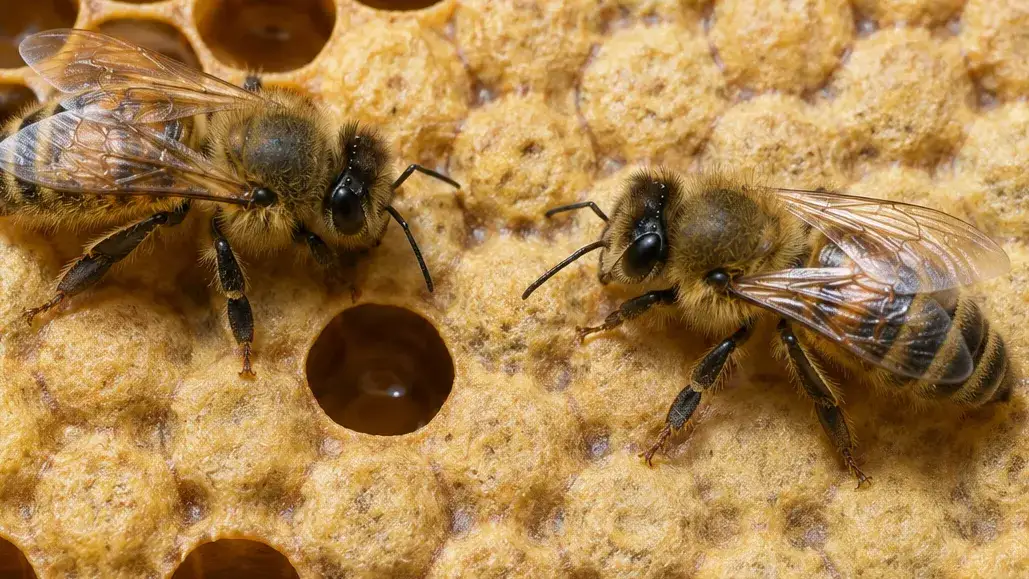
The young worker bee leaves its cell initially with limited capabilities. Many of its crucial functions only fully develop in the following days.
- Development of hypopharyngeal glands
- Building of internal reserves
- Maturation of metabolism
- Physiological resilience
In the first days of life, the young bee is not yet a contributor to the colony’s workforce. It needs to be nourished and integrated into the social structure.
This early phase is often overlooked, despite its critical impact on the potential quality of a future forager.
Nutrition Influences More Than Just Growth
Nutrition is particularly important for the development of the young bee.
Young worker bees particularly need:
- Sufficient pollen or protein sources
- High-quality nutrients
- Good nourishment within the colony
- Effective nurse bees
Pollen provides proteins, fats, minerals, and other elements essential for growth and development.
A lack of high-quality pollen or restricted supply can affect later performance, with consequences often visible only much later.
The Fat Body, the Bee’s Underrated Organ
A particularly intriguing area concerns the so-called fat body. Despite its name, it is one of the bee’s most vital organ systems.
- Energy and protein storage
- Metabolic processing
- Part of the immune system
- Detoxification system
- Reserve for stress periods
Well-nourished young bees often develop better reserves and higher resilience.
Good Nurse Bees Create Good Worker Bees
The quality of new worker bees is closely linked to the quality of the current nurse bees.
Well-nourished nurse bees tend to care for the brood more intensively and consistently, resulting in high-quality young bees.
Where there is a shortage of competent nurse bees or the colony is under nutritional stress, differences can arise, often becoming apparent weeks later.
The First Days Shape the Entire Future Life
- Nourishing performance
- Resilience
- Immunity
- Foraging efficiency
- Lifespan
The future forager is biologically shaped long before its first foray.
Therefore, not only individual bees differ, but often entire colonies.
Why Two Colonies of Equal Strength Can Be Different
Two colonies may appear similarly strong outwardly, yet can develop completely differently.
The cause isn’t always the queen or weather. Often, the quality of the worker bees plays a part.
Colony strength initially describes just a quantity, but what matters is the quality of these bees.
Quality Arises Early
The first days of a worker bee are among the most underestimated phases in a bee colony.
A worker bee does not hatch as a fully developed high-performance bee. Its development continues, influenced by nutrition, care, and the social environment within the colony.
And this is precisely why early development ultimately determines the quality of the entire colony.
Try bee-pilot.io now