Wetter & Phenology
Grassland Temperature Sum (GTS) – Better Timing in Beekeeping
Why Warmth is More Important Than the Date – and How bee-pilot.io Makes GTS Precisely Usable
Nature doesn’t follow a calendar. The start of blooming, the onset of vegetation, and the flow of nectar don’t align with fixed dates but depend on the actual available warmth. This is where the Grassland Temperature Sum (GTS) comes in – a practical indicator to realistically assess the progress of vegetation.
The GTS accumulates the daily positive average temperatures starting from January 1st. Cold days contribute little or nothing to the sum, while warm days increase it significantly. This creates a much clearer picture of how far the year has biologically advanced – regardless of an early end to winter or a delayed start to spring.
Why GTS is Often Better Than the Calendar
Many beekeeping decisions are traditionally based on fixed time points: first inspection in March, colony expansion in April, first nectar flows in spring. In practice, these time frames vary significantly – depending on the year, region, and location.
The Grassland Temperature Sum reflects the actual heat input. This reveals whether vegetation is “ahead” (mild winter, early spring) or “lagging behind” (cool weather, late warming). This helps to prevent actions from being taken too early or too late.
Precise Location with bee-pilot.io
The exact location is always crucial: altitude, exposure, proximity to forests, or valley and slope situations significantly influence temperature development. Regional averages are often too rough for this.
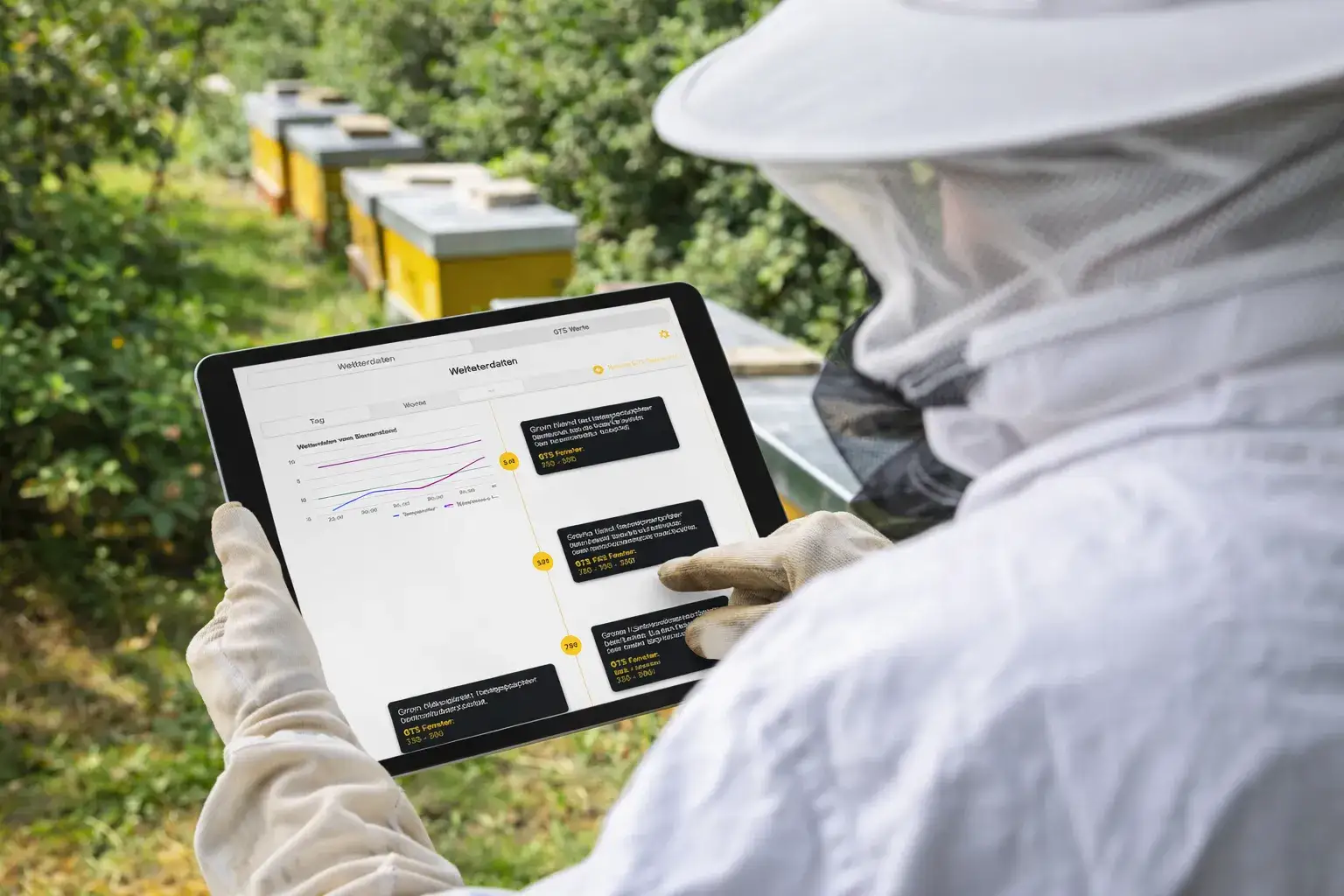
bee-pilot.io calculates the Grassland Temperature Sum precisely for each individual apiary. This results in a realistic assessment of vegetation progress exactly where the colonies are located – not somewhere in the vicinity.
Incorporating Own Observations: Refining Bloom at the Location
The best data remains theoretical if not cross-checked with practice. Therefore, systematically recording personal observations is particularly helpful.
In bee-pilot.io, there’s the option to record bloom observations directly at the location – and, if necessary, edit them specifically. If a bloom is noticed earlier or later than expected, this observation can be documented and adjusted.
Practical Benefits for Beekeeping
The combination of precise GTS and personal observation supports answering timing questions more calmly and reliably – especially for recurring decisions in spring.
- Inspections: better understanding of development status and brood activity.
- Expansion: providing space according to the actual season progress.
- Swarming season: preparation based on vegetation and nectar flow development.
- Nuc planning: more realistic assessment of when the establishment phase starts.
- Yearly comparison: an objective view of “early” or “late” – without calendar fixation.
Conclusion
The Grassland Temperature Sum shows how far the year has biologically advanced – independently of the calendar. With the precise calculation in bee-pilot.io and the possibility to record and refine personal bloom observations, a practical tool is created that sensibly combines data and experience.