Spring Management
Spring Splitting to Prevent Swarming
Balancing Relief and Productivity
Splitting bee colonies in the spring is a classic measure to prevent swarming. However, depending on the management system, opinions on this practice can vary widely. In the two-brood-chamber system, splitting is often an integral part of spring management, whereas in single-brood-chamber systems it is generally approached more cautiously.
This difference is rooted not in mere preference but in differing beekeeping logic. Some beekeepers aim to relieve strong colonies to reduce swarm pressure early on. Others focus on maintaining the strength within the colony and channeling it into the honey supers.
Thus, addressing this topic requires considering both perspectives. Splitting can reduce swarm pressure but may also diminish productivity. In spring, it’s not just any excess mass that is removed from the colony, but often precisely the brood and bees that will soon become foragers. What helps prevent swarming could later be missed in the honey super.
Why Spring is Crucial for This Question
In spring, a bee colony doesn’t just grow in numbers; it builds its entire spring vigor and nectar flow capacity. From the existing brood, bees emerge that collect nectar, fetch water, dry honey, construct comb, and stabilize the hive climate. This phase is vital for the future performance of a production colony.
Particularly strong colonies develop significant pressure during this period. A large influx of young bees, increasing nectar intake, an expanding brood nest, and favorable weather lead a colony biologically towards growth and reproduction. This condition is initially beneficial, as it forms the foundation of a productive production colony. Issues arise when development isn’t properly managed, and the colony starts leaning into a swarming mood.
Splitting intervenes at this point. By removing brood frames and bees, the colony is given relief. The population density decreases, pressure in the brood area is reduced, and dynamics are slowed. This often works effectively, but such relief is not without cost.
What Splitting Truly Means for Production Colonies
When brood is removed from a colony in spring, it loses not just a portion of its current mass but also part of its near future. The removed brood frames would have soon provided new bees for the production colony. These bees would have participated in the nectar flow a short time later or prepared the hive for processing large amounts of nectar.
This relationship is often understated. While splitting reduces swarm pressure, it often simultaneously removes future foragers. This is why it cannot be considered a neutral spring measure. Strong production colonies not only relieve pressure but also give up a portion of future impact. Those aiming for maximum honey yield must view this trade-off very objectively.
This doesn’t imply that splitting is fundamentally wrong. It merely indicates that each brood frame removed for swarm prevention might later be missed in the honey super. The earlier and more intensely splitting occurs, the more pronounced this effect can be.
Why Splitting is Often Recommended in Two-Brood-Chamber Systems
In the two-brood-chamber system, splitting is actively recommended in the spring. In many classic management approaches, it’s almost standard to relieve strong colonies with brood removal or to create nucs. The experience is that strong colonies develop quickly on two brood chambers and can soon reach a state where swarm pressure arises.
From this perspective, splitting is a well-planned tool. It calms the stock, can be linked with nuc creation, and helps slow strong colonies before they enter serious swarming mood. Especially in large operations or where each colony can’t be closely monitored constantly, this method appears practical and safe to many beekeepers.
This approach has its internal logic. Where strong development becomes massive early in two brood chambers, removing brood acts like a valve. Development is slowed, internal pressure decreases, and the colony often remains easier to manage.
Nonetheless, the disadvantage remains: What is removed won’t be available to the production colony later. From a swarm-preventive perspective, this can be beneficial. But regarding honey yield, it often removes precisely the substance one would prefer to have in the honey super a few weeks later. Thus, while splitting is understandable in the two-chambered system, it comes with trade-offs.
Why Splitting is Often Approached more Cautiously in Single-Chamber Systems
In single-brood-chamber management systems, the topic is viewed differently. The focus is not on early relief of strong colonies but on keeping them compact, high-performing, and well-directed. The colony’s strength should remain with the production colony and work into the honey super. Hence, splitting is usually assessed more cautiously here.
A strong colony in a confined, well-managed brood chamber is not automatically too much colony in this logic but often the desired state. The existing strength should not be prematurely removed but used as fully as possible. If splitting occurs too early in such management, it removes not only the peak of development but often exactly the mass needed for strong intake and effective nectar utilization.
Thus, in single-chamber systems, more emphasis is placed on managing swarm pressure initially through management, timing, and honey super addition. Splitting can also be useful here, but more as a targeted intervention in individual colonies and less as a regular standard measure. The focus lies more on directing existing strength rather than prematurely removing it.
The Often Underestimated Importance of the Honey Super
In swarm prevention, the focus is often heavily on the brood chamber, while the genuine importance of the honey super is underestimated. A strong colony needs space to live and work in spring. The nectar collected isn’t immediately ripened honey. It must be removed, distributed, transferred, condensed, and dried. For this, bees require open space.
That’s why it is crucial to give the first honey super in a timely manner. More importantly, ample expansion with additional honey supers is often required. A colony that takes in significant nectar doesn’t only need additional space when the current super is full and nearly capped. It needs continuous work and reserve space for fresh nectar to be processed.
A common mistake is waiting too long. From the outside, there may seem to be space because the top super isn’t entirely filled or capped. In reality, however, a large portion of the existing cells are already in use. Fresh, water-rich nectar occupies space without looking like “full honey” from the beekeeper’s perspective. This quickly leads to a bottleneck.
Why the Top Honey Super Should Never Be Completely Full
The top honey super should never be entirely filled during a good nectar flow. There must always be space for fresh nectar that needs drying. If the top super is largely filled, this buffer is often missing. Processing is slowed upward, even if externally everything doesn’t seem “fully filled.”
This is a key point for strong production colonies. They need storage space for ripe honey, and, more importantly, workspace for unripe nectar. If this space is too limited, the workflow stalls. Nectar cannot be freely distributed anymore, bees lose movement and processing space, and some internal pressure starts building downward again.
Precisely in this phase, insufficient honey super management can magnify swarm pressure. Therefore, the next honey super should not only be added when the top one is fully exploited. It should already be present while there is still ample space for ongoing intake and drying. Waiting until the top super is nearly full often means expanding too late.
Adding Versus Under-supering the New Honey Super Isn’t a Rigid Rule
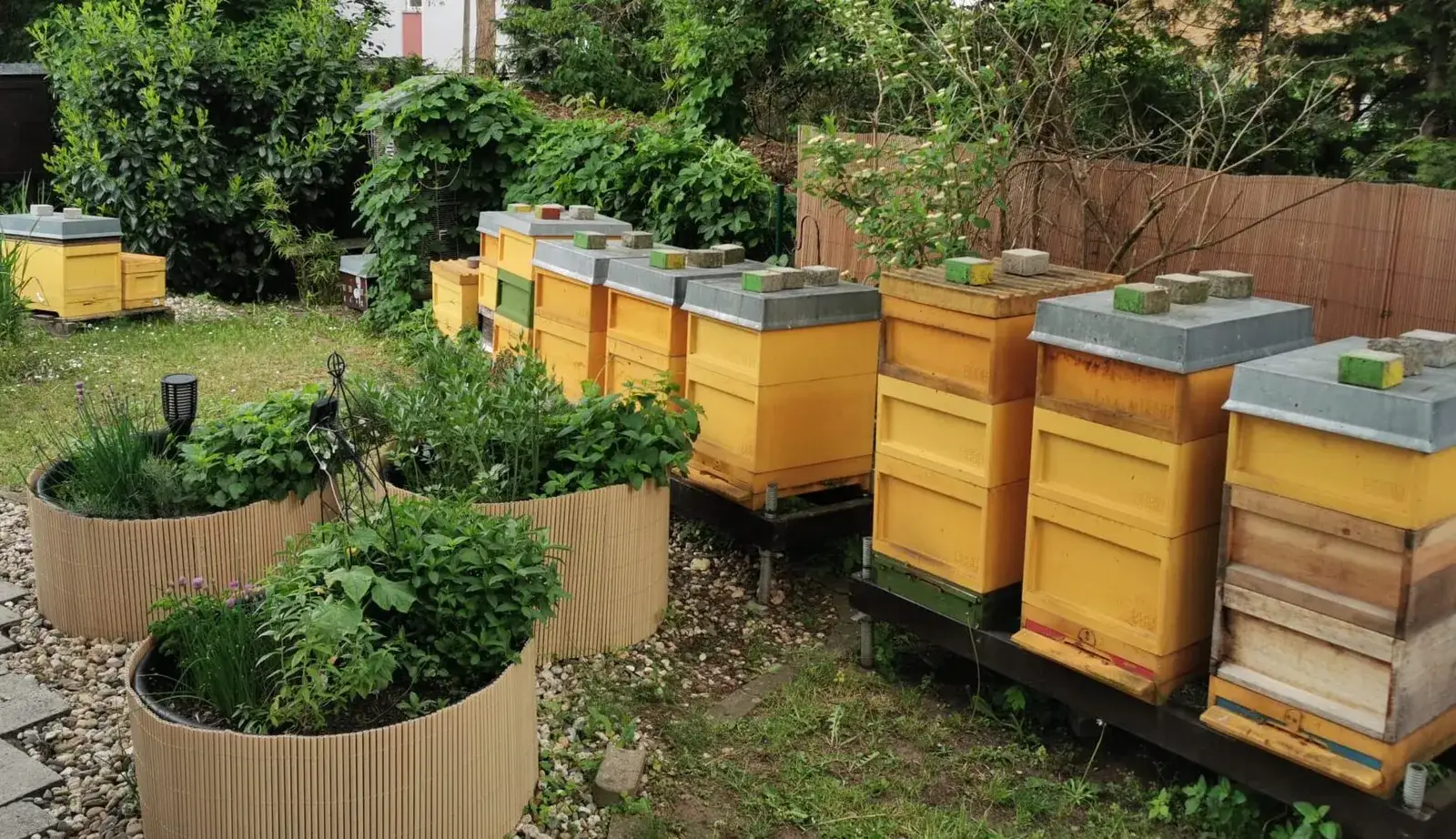
How a new honey super is added is much debated. Some beekeepers add the new honey super on top; others place it under the already accepted one. There is no single answer. Much depends on management style, nectar flow, colony strength, and bee behavior.
The bee race or breeding line can also play a role. With Carnica, it’s often noted that they store honey closer to the brood nest. Therefore, some beekeepers with such lines prefer under-supering. Conversely, with Buckfast, top-supering is often favored. These tendencies are repeatedly observed in practice, but they are not unalterable rules.
Ultimately, each beekeeper must judge this within their own operation. Not every line behaves the same, and even within a race, individual colonies can show different behaviors. What matters less is turning this into a doctrine and more that expansion occurs at the right time and is well-received by the colony. Whether to top-super or under-super should be decided based on individual observation and experience.
The Real Contrast Between Both Management Styles
The central difference between the two-chamber and single-chamber perspectives is not whether splitting can fundamentally work. It can. The difference lies more in strategic prioritization.
In the two-chamber system, splitting is often seen as a normal part of spring management. Part of the colony’s mass is intentionally removed to calm development and reduce swarm pressure early.
In the single-chamber system, more emphasis is placed on keeping this mass within the production colony and channeling it into the honey super through good management. There, the loss of future foraging strength often weighs more since the compact spring development is seen as the foundation for productivity.
Both approaches have their internal logic. One tends to remove substance to create more calm, while the other seeks to retain and productively utilize the existing substance.
When Splitting Can Be Useful
Splitting can indeed be useful when a colony is very strong, development pressure is high, and there are clear trends towards swarming. If nucs are to be deliberately formed or a style consciously employs this relief, the measure can be appropriate.
What’s crucial is that the intervention is deliberate and not reflexive. Those who split should be aware that they not only reduce swarm pressure but also the colony’s future productivity. Thus, the measure becomes an intentional deliberation and not an automatic action.
When More Honey Supers Are Often the Better Route
Especially for strong production colonies, it is often smarter to work with the honey super first rather than prematurely remove substance from the colony. Timely and sufficient honey super space maintains the strength within the colony, allowing it to convert strength into intake rather than lose it through removal.
From a single-chamber perspective, the more crucial lever often lies here. Not to split hastily but to channel the existing strength upwards through management and space. This requires that enough space for fresh nectar is always available and that the top honey super never becomes completely filled.
Conclusion
Spring splitting can reduce swarm pressure but is not a neutral measure. In the two-brood-chamber system, it is often considered a sensible and widely used tool for spring management. In the single-brood-chamber system, it is generally viewed with more caution because there it is emphasized more that every brood frame removed also costs future foragers and thereby often honey.
Thus, the focus automatically shifts to the honey super. Strong colonies, in particular, need ample room early and continuously for nectar that still needs processing and drying. The top honey super must never be so utilized that this workspace is practically absent. Whether another honey super is top or under-supered depends on management style, bee line, and personal experience and cannot be uniformly answered for every operation.
In the end, splitting remains a strategic decision. Those who remove substance often gain relief but frequently lose part of the later nectar flow potential. Those who retain strength in the colony must manage more precisely and provide the honey super very promptly to ensure the full potential of the production colony is maintained.
Test bee-pilot.io now