Beekeeping Knowledge
Water at the Apiary: Why It Is Crucial for the Colony and Which Bee Waterers Are Truly Beneficial
Water is one of the most underrated factors at the apiary – yet it is indispensable for brood care, digestion, and hive climate.
In beekeeping, water is often given significantly less attention than feed, brood, or forage. Yet it is one of the fundamental prerequisites for a bee colony to function stably in spring and summer. A colony needs not only nectar and pollen but also constant access to water. If this access is lacking or requires great effort, additional stress can quickly arise for the colony.
Because water seems so self-evident, its importance is often underestimated. Bees usually find water somewhere. However, the critical question is not whether they find water at all, but how far they have to fly for it, how safe this source is, and whether it is permanently available. This is precisely where water transforms from a side aspect to a real performance factor at the apiary.
In 60 Seconds
- Water is important for brood care, digestion, and hive climate
- Especially in spring and on hot days, the demand increases significantly
- Having an on-site bee waterer eases the colony and avoids problem sources in the neighborhood
- Proven designs are shallow, structured waterers with safe landing spots
- Open, deep, and smooth water surfaces are unsuitable as drinking spots
Why Water Is So Important in the Colony
Water is needed in the bee colony for several core tasks. It serves not only the immediate needs of individual bees but is continuously processed and used within the colony.
A key point is brood care. As a colony rears more brood in the spring, the need for water rises significantly. Nurse bees must feed the brood, prepare food, and maintain stable brood conditions. The more larvae are cared for, the more it matters whether water is readily available or requires effort to obtain.
There’s also the processing of food. Stored food or thick food reserves must be made available within the colony in a form that bees can use. Water is crucial for this, too. Especially in phases when there is little fresh input or reserves are used, this plays a larger role than often assumed.
As the year progresses, the regulation of the hive climate becomes important. Especially in warmer weather, bees use water to influence the climate inside the hive through evaporation. This is particularly relevant for strong colonies with a lot of bee mass and high activity. If water is not available nearby, the effort increases significantly.
Thus, water is not just an add-on but a substance directly linked to brood care, digestion, and climate stability. A colony that must fly far in good development to fetch water loses time, energy, and foraging efficiency.
When Water Becomes Especially Important
Water becomes particularly relevant whenever the colony must perform extensively. This is primarily in spring when brood areas grow, and the supply demand increases. During this phase, water can quickly seem scarce, even if from the outside you only see flight activity or pollen baskets.
Dry weather conditions also exacerbate the problem. Even if it’s sunny and bees are flying, this does not automatically mean that sufficient suitable water sources are available. Puddles dry up, moist soil spots disappear, and small natural water sources are often insufficient for several strong colonies.
In summer, the focus shifts somewhat. Water is then not only relevant for brood but increasingly for cooling and climate regulation in the hive. Especially on hot days, this can become a crucial point.
Additionally, the location plays a big role. At wind-exposed, dry, or very tidy locations, natural water sources are often lacking. Even nucleus colonies or smaller units can be affected since additional strains become noticeable more quickly.
Why Having Your Own Bee Waterer Makes Sense
Many beekeepers think that bees will take care of themselves. That’s fundamentally true but falls short. Bees will fetch water from gutters, puddles, ponds, bird baths, kiddie pools, or dirty corners if necessary. The problem isn’t that they can’t find anything, but that they often choose sources that are inconvenient for the beekeeper or the neighborhood.
A good bee waterer has several advantages. It shortens search flights, eases the colony, diverts bees from problematic water sources, and makes provisioning more predictable. What’s crucial is that it’s available early in the year. Bees memorize water sources. Anyone who sets up a waterer only after bees have become accustomed to the neighbor’s rain barrel often has bad luck.
Which Bee Waterers Are Beneficial
Not every water site that looks neat is truly suitable for bees. Bees need safe landing spots. Deep, smooth open water surfaces are unfavorable. A good bee waterer must be constructed so that bees can drink without risk.
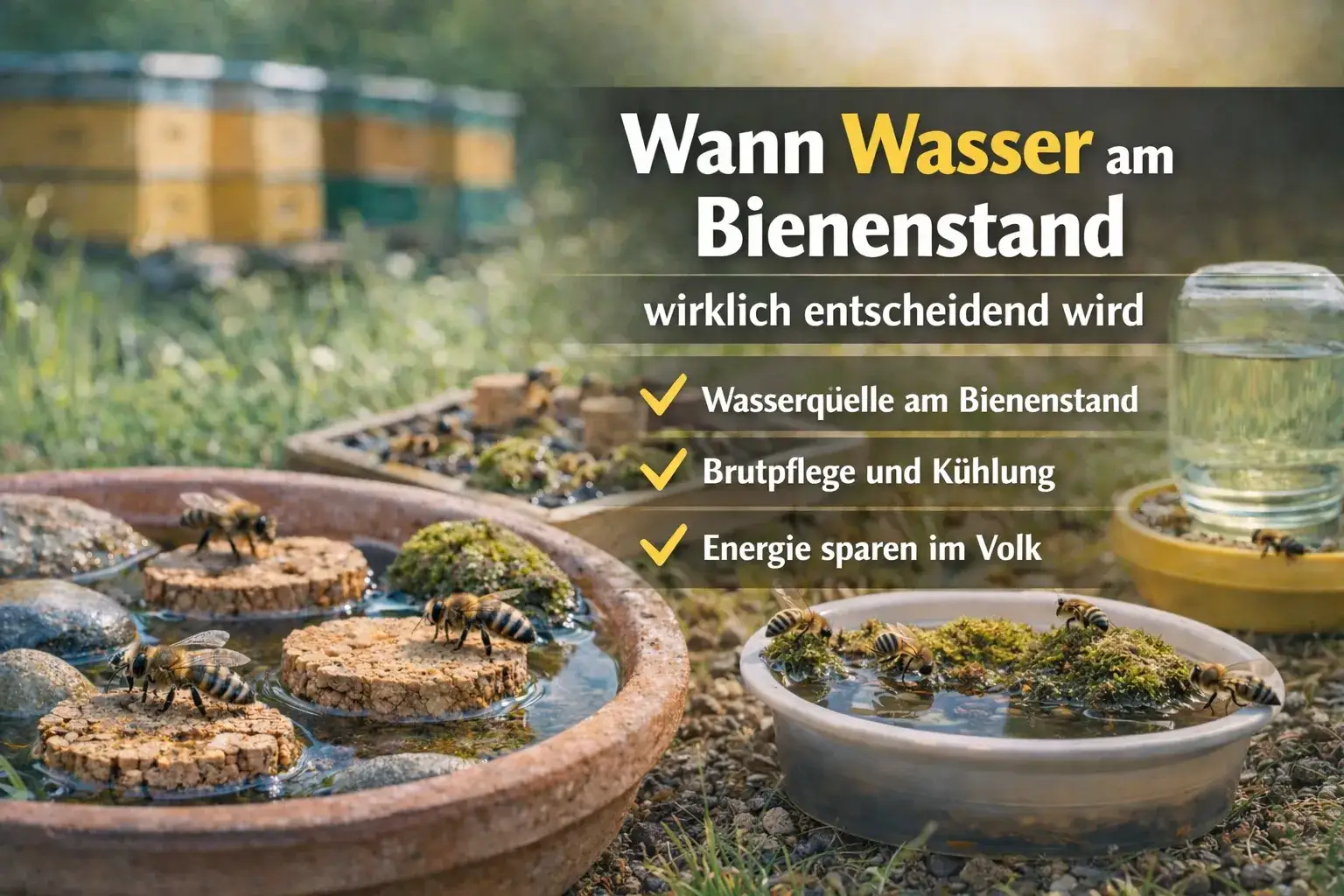
1. Shallow Dish with Stones, Gravel, or Corks
This is one of the simplest and most useful solutions.
Instructions: Take a wide plant saucer, a shallow tub, or a low container. Fill it with coarse gravel, small stones, corks, or pieces of wood. Add water, but only so much that many dry or slightly moist landing surfaces remain.
Advantages: This solution is simple, cheap, and quickly built. Bees can land safely and hold on well. The risk of drowning remains low if enough structure is present.
Disadvantages: The water evaporates relatively quickly. The waterer must be refilled regularly. It also gets dirty over time and needs to be cleaned.
2. Shallow Waterer with Reservoir
This variant is useful if you don’t want the water site to run dry constantly.
Instructions: Use a canister, bucket, or small container as a reservoir. Slowly lead water from it into a shallow drinking dish. Again, stones, corks, or similar landing options must be present in this flat zone. The water flow should not be so strong that the dish is flooded.
Advantages: The system lasts longer and needs less frequent refilling. For larger sites, this is often more practical.
Disadvantages: The setup is somewhat more complex. If too much water flows in, the safe landing spots disappear, and bees can drown more easily.
3. Moist Waterer with Jute, Felt, Hemp Mat, or Sponge
Here, bees don’t drink directly from an open water surface but from a moist surface.
Instructions: Place jute, felt, a hemp mat, or another absorbent natural material on a flat base. Keep this material moist by pouring in water or using a very small water flow. The bees sit on it and take up water from the surface.
Advantages: The risk of drowning is very low. Bees have plenty of grip. Such waterers are often well-accepted.
Disadvantages: The material can get dirty or rot over time. It must be checked, cleaned, and regularly replaced.
4. Natural Waterer with Sand, Moss, Soil, or Clay
This form is more oriented towards natural water sources, which bees frequently use outdoors.
Instructions: Take a shallow tub and create a transition from wet to dry. One area can be covered with sand, moss, clay, small stones, or some soil. The water should only be partially open. A moist, structured surface is better than a deep bare water zone.
Advantages: Such waterers are often well accepted. Bees often prefer slightly mineral or organically shaped water sources to completely bare water.
Disadvantages: The waterer gets dirty faster and must be monitored. If it becomes too muddy or fetid, it is no longer useful.
5. Large Containers like Barrels, Tanks, or Buckets
This sounds practical but is usually not a good solution as an actual drinking site.
Instructions: If you want to use a large container, it should only serve as a water store. Drinking should not be directly at the open water surface but at a separate shallow zone with safe landing places.
Advantages: Large water reserve, hence less frequent refilling.
Disadvantages: As an open water surface, a barrel or bucket is unsuitable. Deep smooth containers can easily lead to losses. Without a safe drinking zone, it’s not a good bee waterer.
What Not to Do
A common mistake is simply placing a bucket, bowl, or tub with a bare water surface. That’s not sufficient. Bees need secure structures to sit on. Deep smooth water surfaces are unsuitable.
Occasional filling of waterers is also unfavorable. If the water source dries up, bees quickly find another one. Redirecting this habit is often challenging.
A location in full shade is usually also poor. There, the water stays cool and is often less accepted. Additionally, very windy locations are unfavorable.
It’s also not advisable to constantly change the location of the waterer. Bees remember water sources. Consistency is more important than continuous relocation.
Caution is also advised with unnecessary additives. You should not add dubious substances to the water just to make the waterer more attractive. A safe, clean, structured, and permanently available water source is generally completely sufficient.
What Has Proven Effective in Practice
The best results usually come from simple, shallow waterers with plenty of safe landing options. Often, a wide dish with gravel, stones, and a few corks is entirely sufficient if it is placed in the sun, set up early, and does not dry out.
If you have multiple strong colonies or do not want to refill constantly, a combination of a reservoir and a shallow drinking area often works better. However, the same point always remains crucial: Not the water amount alone, but the secure accessibility for the bees counts.
Conclusion
Water is not a side aspect in the bee colony; it is a continuously needed component of internal supplies. It is needed for brood care, food processing, and climate regulation. Especially in phases of strong development, a good water source can make the difference between a colony that works efficiently and one that carries unnecessary additional burdens.
A good bee waterer need not be complicated. It is crucial that it is available early, safely usable, structured, and permanently accessible. Deep smooth water surfaces without landing opportunities are unsuitable. Proven designs include mainly shallow systems with gravel, stones, corks, or other secure landing platforms.
Try bee-pilot.io now