From Hive to Desk: Why Developing bee-pilot.io is So Exciting
As beekeepers, we build bee-pilot.io right where it needs to work: at the hive.
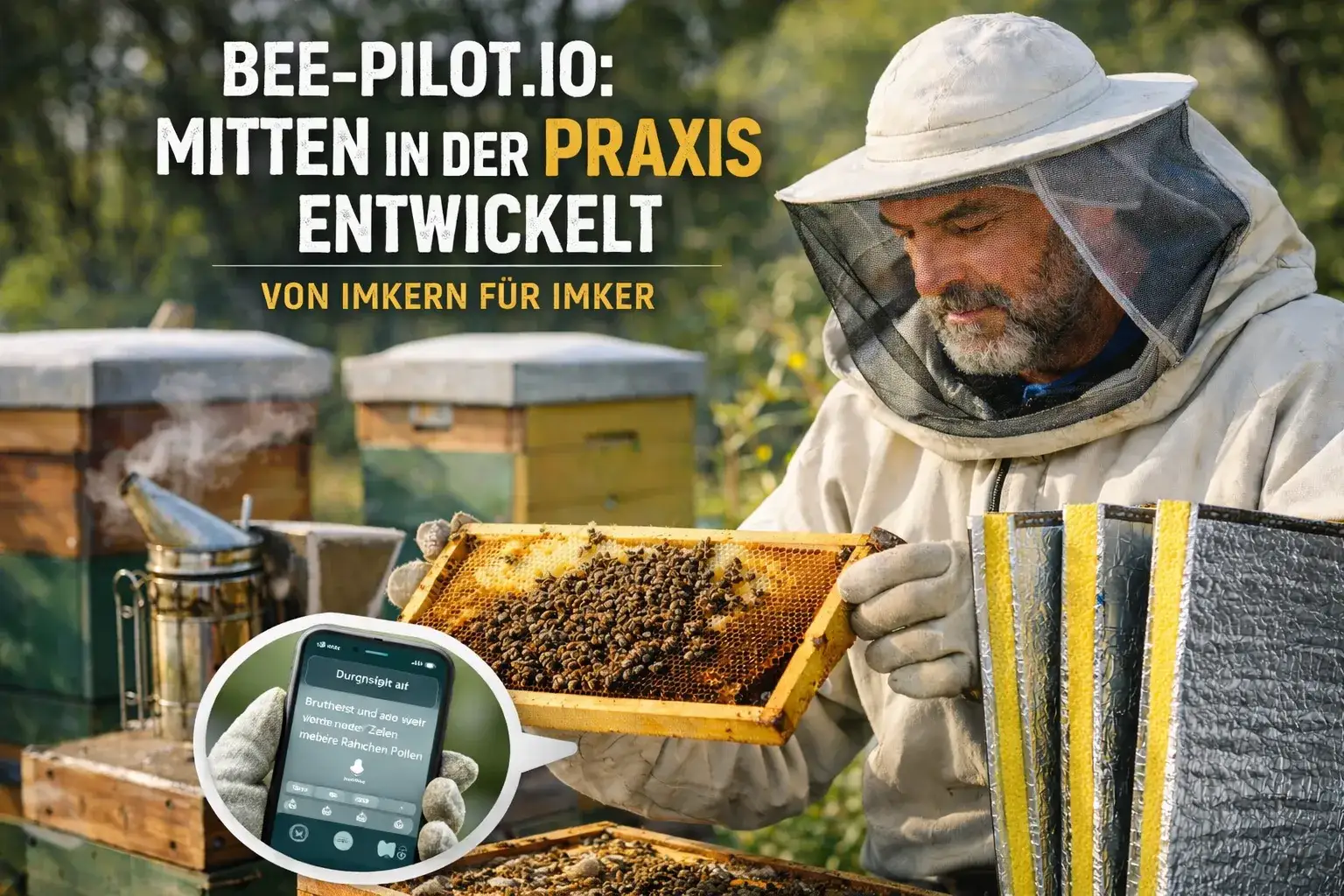
Beekeeping isn’t an office job. It smells of smoke, propolis sticks to your fingers, and sometimes the buzzing is louder than you’d like. Right in this environment, bee-pilot.io is created—not in a quiet office, but in the thick of it. We don’t develop at a desk for a theoretical audience: we are beekeepers ourselves and test new ideas exactly where they need to work later.
That’s why development is so exciting. Sometimes chaotic, often educational—but always with the goal of making everyday life in beekeeping a little easier, without it feeling like “even more tech.”
Many Beekeepers, Many Approaches
The age range in beekeeping is broad—and so are the methods. Some have long gone digital, while others swear by hive cards and notebooks. Many fall somewhere in between: curious, open, but not necessarily tech-savvy with new media.
That’s where we come in. Our goal with bee-pilot.io is to reach as many beekeepers as possible—without being didactic and without complicated processes. If it fits into daily life, it’s fun. And when it’s fun, you stick with it.
Development Means: Testing, Laughing, and Refining
Many features are born, not at the whiteboard, but after a comment like: “That was a bit cumbersome… surely there’s an easier way.” Then the tinkering begins.
At the hive, it becomes quickly apparent whether an idea is worth it: gloves, veil, sun, sticky fingers, little time—under these conditions, it has to work. That’s why in bee-pilot.io, we constantly test variations, sometimes discard things, and keep refining until it feels right in practice. Theory is good—but practice is honest.
Gloves, Veil, and Touchscreens—Our Answer: Voice Input
Anyone who has tried typing on a smartphone with beekeeping gloves knows: It’s about as graceful as opening a honey jar with a hive tool. It can be done—but it’s no fun.
So it was clear: In bee-pilot.io, inspections should be entirely via voice input. Simply speak observations, save, and continue working. No tapping, no swiping on the screen—and the focus remains on the bees.
No Phone at the Hive? That Works Too.
Some beekeepers don’t want to take their phones to the hive. And honestly: We understand. That’s why in bee-pilot.io, there’s the classic way that many already like.
You can print checklists, fill them out at the hive as usual, and later scan them using a smartphone or tablet, directly into bee-pilot.io. The values are recorded—and you still have everything digitally at your fingertips. Tried and true at the hive, modern in evaluation.
More Than Just a Provider: We Want to Be Part of the Community
bee-pilot.io isn’t just a product for us. We aim to be not just a “provider” but part of the beekeeper community. That’s why we regularly share expert articles on social media, share practical experiences, and spark discussions worth having.
We love engaging discussions—even if not everyone agrees. That’s how progress happens. And along the way, you often pick up a trick or two to try out at the hive the next weekend.
Conclusion
Our vision with bee-pilot.io is clear: Technology should adapt to beekeeping—not the other way around. We want to help capture knowledge, see developments better, and maintain an overview, without it feeling like extra work.
And because every apiary is different, we welcome every tip—positive or negative. Write to us, comment, engage with us. Because bee-pilot.io should not only be developed by beekeepers but grow together with the community.
Try bee-pilot.io now!