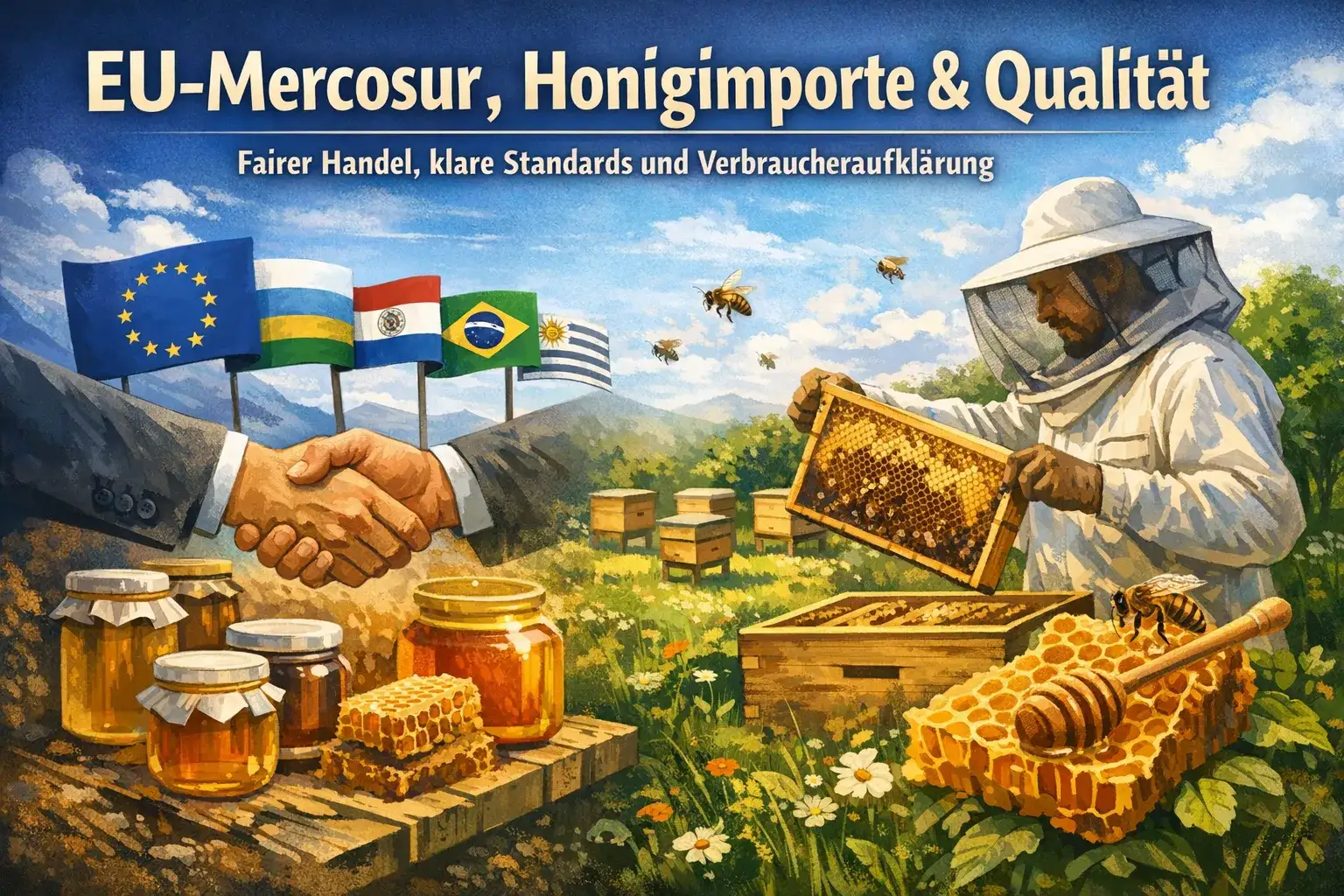
EU-Mercosur & Honey Market
Why Imports Must Remain Fair – and Why Local Beekeeping, Clear Standards, and Consumer Education Are More Important Than Ever
The ongoing discussion about the planned EU-Mercosur trade agreement might seem abstract to many. However, for beekeepers, it’s very tangible: it affects the pricing of honey, the competitiveness of regional operations, and the trust consumers place in a natural product increasingly suspected of being adulterated.
At the same time, the debate shows that it’s not just about “more or less import.” What matters is how fair the market is, how clearly quality is defined, and how well consumers understand what they are actually buying. Responsibility thus lies both with policymakers and the industry itself.
Trade Is a Reality – but Fairness Decides
The European Union is not self-sufficient when it comes to honey. A significant portion of consumption has to be imported. Thus, imports are structurally part of the market and will remain necessary in the future. The proposed trade agreement with the Mercosur countries (Brazil, Argentina, Paraguay, and Uruguay) aims to reduce trade barriers and open new market opportunities.
For honey, discussions include introducing additional duty-free import quotas. The EU Commission mentions approximately 45,000 tons that could gradually enter the European market duty-free. Currently, the EU already imports substantial amounts of honey from third countries – Eurostat estimates total imports for 2023 at approximately 163,700 tons.
Sources:
EU Commission: https://policy.trade.ec.europa.eu/eu-trade-relationships-country-and-region/countries-and-regions/mercosur_en
Eurostat: https://ec.europa.eu/eurostat/statistics-explained/index.php?title=Honey_production_and_trade_statistics
These figures show that the European honey market is highly international. A fair market, therefore, doesn’t mean rejecting imports outright – but ensuring that competition occurs under comparable conditions and quality remains verifiable.
Price Pressure Doesn’t Begin with New Agreements
For many beekeepers, the economic pressure is already tangible. In direct sales, it’s increasingly difficult to justify prices to consumers who compare them to supermarket honey. Imported and blended honeys are often offered at prices that are hardly comparable to artisanal, regional beekeeping.
Working hours, investments in hygiene, traceability, winter losses, feed costs, or site maintenance are often invisible to customers. The shelf price becomes the reference – regardless of how different the production realities are. Additional import volumes can exacerbate this effect by further pressuring or keeping the general price level low.
“Fake Honey”: When Trust Becomes a Market Risk
Parallel to the import discussion, the issue of honey adulteration is gaining focus. A coordinated investigation by the EU Commission from 2021–2022 found that 46% of the import samples examined were deemed suspicious due to indications of possible non-compliance with the honey directive – for instance, through the addition of sugar or syrup components.
Source:
EU Commission: https://food.ec.europa.eu/food-safety/eu-agri-food-fraud-network/eu-coordinated-actions/honey-2021-2022_en
This topic has also been picked up by the media and associations. ZDF released the documentary “Fake Honey – A Sweet Illusion” on 05.08.2025, highlighting international supply chains and modern adulteration methods. The German Beekeepers’ Association (D.I.B.) acknowledged these findings and reported on its efforts towards education and research projects against honey adulteration on 08.08.2025 and 09.01.2025.
Sources:
ZDF: https://www.zdf.de/video/dokus/frontal-doku-100/fake-honig-eine-suesse-illusion-100
D.I.B.: https://deutscherimkerbund.de/honigverfaelschung-auf-der-spur/
D.I.B.: https://deutscherimkerbund.de/honigproben-gegen-honigverfaelschung/
This is problematic for honest beekeepers: If consumers get the impression that “honey is often tampered with,” it undermines confidence in the entire product segment – even where things are done cleanly and transparently.
Quality Needs Clear Definitions and Control
Legally, honey is clearly defined in the EU. The so-called Honey Directive lays out what can be sold as honey, what composition is permissible, and how it must be labeled.
Sources:
https://agriculture.ec.europa.eu/farming/animal-products/honey_en
https://eur-lex.europa.eu/EN/legal-content/summary/eu-labelling-rules-for-honey.html
However, practice shows that rules alone are not enough. What’s crucial is that they are technically verifiable, consistently controlled, and understandably implemented for consumers. As import volumes increase, the capacities for controls, analytics, and traceability must keep pace – otherwise, an imbalance occurs to the detriment of serious providers.
A fair market therefore means not only equal tariff conditions but also equal quality standards and equal enforcement of the rules.
Consumer Education: Understand Quality, Make Informed Decisions
A fair market only functions if consumers understand what they are buying. Many purchasing decisions today are driven mainly by price and taste. Origin, production methods, blends, or quality criteria often remain abstract – even though they are crucial for sustainability, transparency, and value creation.
Consumer education means:
- explaining what “honey” legally means and why not all honey is alike,
- making visible the differences between regional beekeeping and anonymous import blends,
- demonstrating the role of traceability, hygiene, processing, and storage,
- and conveying why quality and regional value creation have their price.
Only when consumers can comprehend these contexts do conscious purchasing decisions emerge – and a market that rewards quality instead of just the lowest price.
The Position of the German Beekeepers’ Association
The German Beekeepers’ Association has been critically following the developments around honey imports and market transparency for years. In publications, the association points out that additional imports can increase price pressure and that more transparency, better controls, and clear labeling of origins are necessary. This position underscores that the concerns are not ideological, but professionally justified.
Conclusion: Fair Trade Needs Clear Rules – and Strong Local Beekeeping
Imports are part of the reality of the European honey market. However, a fair market only arises when quality is clearly defined, consistently controlled, and communicated understandably to consumers. Increasing import volumes without corresponding control mechanisms and transparency heighten the risk of market distortion and loss of trust.
At the same time, great responsibility – and opportunity – lies within local beekeeping itself: through clean operations, transparent documentation, nurturing young talents, and modern tools for business organization. Only then can regional beekeeping sustainably move away from pure price competition and make its value visible.
A fair market is not a coincidence. It arises from clear rules, credible quality, and informed consumers.
More articles on beekeeping, market & digitization?