Betriebswirtschaft & Praxis
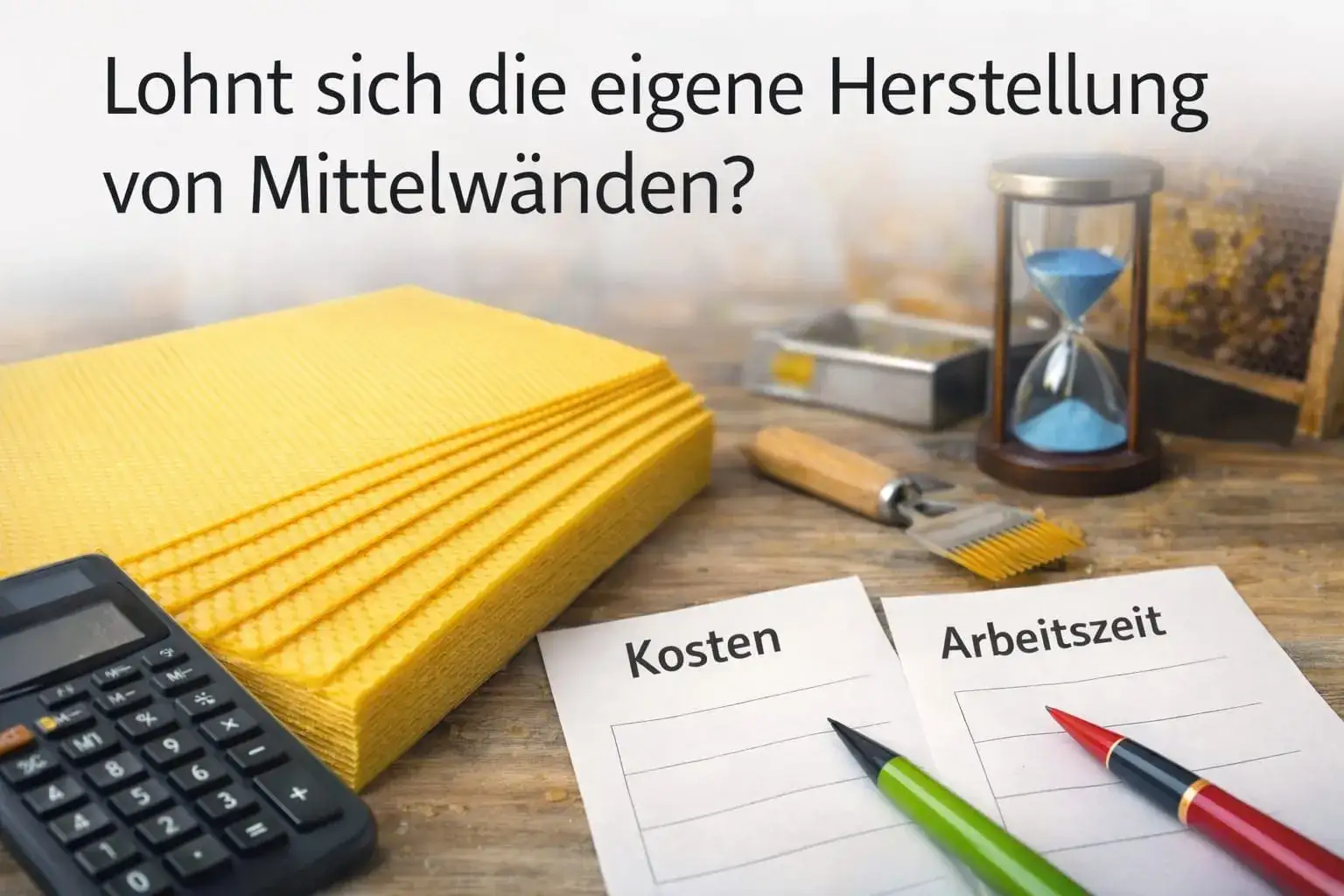
Making Your Own Foundation Sheets – Hobby or Economically Viable?
Why DIY production is often emotionally assessed – and its real economic perspective.
The question of whether to make your own foundation sheets for beekeeping is often discussed emotionally. Many associate it with independence, control over their own wax cycle, and the joy of craftwork. However, when viewed from an economic perspective, a more nuanced picture emerges.
1. Technical Requirements
For DIY production, in addition to a wax melter, you primarily need a foundation press (manual or water-cooled), a casting or tempering facility, suitable workspaces, as well as time for cleaning and maintenance. Realistically, the investment cost for a solid press is around 800–1,200 €. Assuming a lifespan of ten years, this results in an annual depreciation of about 100–120 €.
2. Time Investment – The Decisive Factor
The economically crucial point is not the technology, but the labor time. For about 25 kg of wax per year, several work steps are involved: preparation and heating, pressing or casting, trimming and inspection, and cleaning the equipment. Practically calculated, this totals about 4–5 hours per cycle.
Assuming a moderate business owner wage of 20 € per hour, the labor costs alone amount to 80–100 €. As the amount of wax increases, the workload rises almost proportionally, meaning larger beekeeping operations can quickly invest several full working days per year in DIY production.
3. Comparison with Processing
With processing costs of around 4 € per kg, about 100 € costs accrue for 25 kg of wax. In contrast, DIY production incurs depreciation, labor time, as well as energy and wear costs, totaling about 210 € in this example. Thus, DIY production often costs more than double that of paid processing.
Even with larger quantities, the advantage barely changes, as the time investment increases significantly and the process remains labor-intensive.
4. Efficiency with Larger Quantities
A common misconception is that DIY production becomes much more worthwhile with greater wax quantities. Although fixed costs are spread out better, the labor time proportion notably increases. The process remains hardly automatable and thus still labor-intensive. Entrepreneurially, this time must be considered lost working time in other business areas.
5. Non-Monetary Aspects
Despite an economic consideration, there are good reasons for DIY production: the joy of craftwork in winter, the feeling of complete control over the wax cycle, independence from service providers, or a meaningful activity during quieter months. If the activity is consciously viewed as a hobby and one’s labor time isn’t valued, it can indeed be personally worthwhile.
Conclusion
DIY production of foundation sheets is seldom economically profitable. It is mainly sensible when pursued as a hobby, when one’s labor time isn’t calculated, or when there are very specific quality requirements. For beekeepers working efficiently and realistically valuing their time, processing at market prices is, in most cases, the significantly more economic solution.
More practical knowledge for efficient beekeeping?