Honey Market & Quality
Honey That’s Too Cheap – Why Quality Must Have Its Price
Why extremely low prices harm not only beekeepers but also trust and transparency in the honey market.
An Underestimated Food
Honey is considered a natural product, a symbol of regional craftsmanship, and a healthy sweetener. At the same time, in Germany, it’s often sold at prices that barely reflect the actual production costs. While consumers willingly spend high amounts on coffee, wine, or cheese, honey is often perceived as an interchangeable mass product.
This development has consequences: Many artisanal beekeepers find it challenging to cover costs under current market prices.
What Does Good Honey Really Cost?
Beekeeping is labor-intensive and associated with substantial costs:
- Acquisition and maintenance of hives and frames
- Varroa treatment and animal health
- Feed costs
- Jars, labels, storage
- Transport to nectar areas
- Time spent on care, harvesting, extracting, filtering, bottling, marketing, and education
Depending on the size and yield of the operation, realistic production costs for a 500-gram jar of artisanally produced honey often range from €6-8 or more, if labor is fairly calculated.
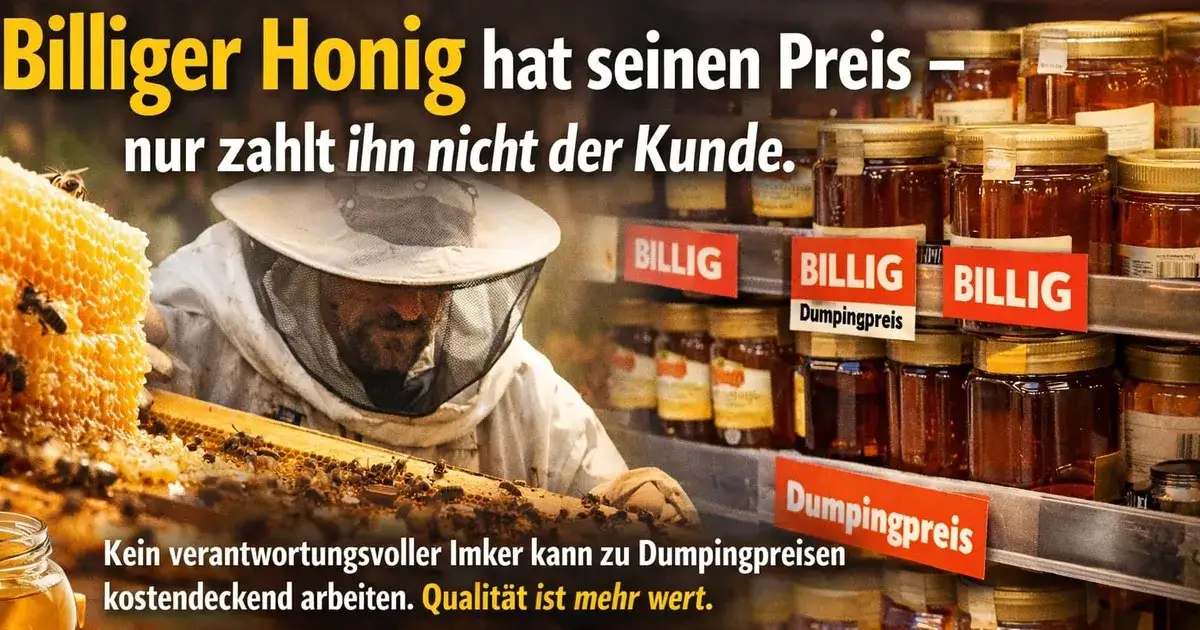
In grocery stores, however, imported honeys are sometimes offered for significantly less than €4 per 500 grams. These prices are practically unattainable for small beekeeping operations.
International Price Comparisons
It is notable that honey is often sold at higher prices in countries with significantly lower per capita income compared to Germany. Examples from Southern European or non-European regions show: there, honey is perceived more as a high-quality natural product, sometimes even as a remedy. Prices of €25-35 per kg are often demanded there.
In Germany, by contrast, honey is frequently compared with industrially produced sweeteners. The price is oriented less towards artisanal quality and more towards discount offers.
Import Pressure and Market Distortion
Germany is among the largest honey importers worldwide. A significant portion comes from countries like:
- China
- Ukraine
- Argentina
- Mexico
Imported honeys are often traded at very low prices. For years, there have been indications from scientific studies and market analyses that a portion of the honey traded globally is diluted with syrups or incorrectly labeled. Modern analytics repeatedly reveal anomalies, but not every adulteration is easily detectable with standard tests.
It’s important: Not every imported honey is adulterated. But the price pressure from extremely cheap goods, regardless of quality, influences the entire market structure.
For consumers, the impression arises: “Honey is cheap.”
For beekeepers, the reality is: “Honey is undervalued.”
Quality Is More Than Just Sweetness
Artisanally produced honey differs in several aspects from industrially mixed offerings:
- Origin from clearly defined nectar areas
- Purity of variety (e.g., rapeseed, linden, or forest honey)
- Gentle processing without excessive heating
- Preservation of natural enzymes and aromatic substances
- Transparency about the producer and production method
A jar of regional honey is not a standardized industrial product. It reflects floral diversity, weather conditions, and craftsmanship.
Supply and Demand – But with Distorted Perception
In market economy terms: Price results from supply and demand. Yet demand is based on perception. If consumers primarily perceive honey as an inexpensive sweetener, willingness to pay shifts downward. Quality then plays a subordinate role.
In Germany, the expectation has emerged that honey must be a cheap everyday product. This “price anchor thinking” is stronger than objective production costs.
Consequences for Beekeepers
Prices too low in the market lead to several problems:
- Economic pressure on small businesses
- Fewer newcomers to beekeeping
- Focus on part-time rather than full-time operations
- Dependency on direct marketing
In the long term, this not only endangers individual operations but also the pollination services essential for agriculture and biodiversity.
Why Consumer Prices Often Do Not Reflect Reality
A kilogram of sugar costs a few euros. A kilogram of honey is created through the gathering work of millions of flower visits per jar, overseen by a beekeeper throughout the year.
When counting labor, risk (weather, disease, harvest failures), and investments, it becomes clear: Extremely cheap honey is only possible through economies of scale, international price differences, or quality compromises.
What Needs to Change
- More transparency about origin and analysis methods
- More conscious purchasing decisions by consumers
- Clear distinction between artisanal honey and mass-produced goods
- Fair pricing in trade
Quality cannot be consistently sold below value without structures collapsing.
Conclusion
The German honey market suffers less from a lack of product quality than from a distorted perception of prices.
As long as honey is predominantly viewed as a cheap standard product, it remains challenging for many beekeepers to work cost-effectively. Yet high-quality honey is a regional natural product with significant labor and environmental value.
A realistic price is not a luxury but a prerequisite for preserving artisanal beekeeping, biodiversity, and quality in the long term.
Try bee-pilot.io now