Population Development
Longevity of Workers
Why a Large Brood Alone Doesn’t Make a Strong Colony
A strong bee colony is often first assessed by its brood area. Large brood nests, a lot of capped brood, and a vigorous queen seem impressive at first glance. And brood is essential: without brood, there is no offspring, no colony development, and later no forager bees.
However, a lot of brood alone is not a sufficient quality feature. The key is not only how many bees a colony produces but especially how long the emerging workers remain healthy, productive, and useful within the colony.
The focus is, therefore, on the longevity of the workers: nurse bees, house bees, forager bees, and especially winter bees. Here lies a crucial difference between sheer brood enthusiasm and genuine colony performance.
Brood is Just a Promise of Bee Mass
A large brood area initially only shows that many bees could emerge. Whether it actually becomes a strong colony is determined afterward. The emerged workers must be healthy, have sufficient reserves, be well nurtured, and live long enough to be truly useful to the colony.
In every colony, two developments occur simultaneously: on one side, young bees emerge, and on the other side, workers die. The actual colony strength results from the ratio of these two processes.
If many young bees emerge, but the workers live only briefly, the colony grows little or only temporarily. Then it constantly operates in replacement mode: it produces a lot of brood but simultaneously loses many bees due to wear, disease, varroa damage, poor provision, or unfavorable management.
The decisive question is, therefore, not: How much brood does the colony have?
But rather: How much long-lived worker mass arises from this brood?
Worker Longevity Determines Real Colony Strength
A worker that lives only briefly provides little working time to the colony. A worker that remains healthy longer can nurse, warm, build, process nectar, fetch water, defend, and later forage.
For the performance of a colony, it’s not just the number of bees on a certain day that counts. What matters is how many bees remain functional over a longer period.
A colony with slightly less brood but longer-lived workers can be more productive than a colony with a massive brood area but short-lived bees. When workers live longer, the bee mass remains more stable. The colony needs less energy (honey/pollen) to constantly replace losses.
You can think of this in terms of “bee-days.” A bee that lives longer delivers more usable work time to the colony. Many short-lived bees can appear strong visually but provide biologically less performance than a slightly smaller but more stable colony.
Summer Bees and Winter Bees: Two Different Life Strategies
Regarding worker longevity, one must distinguish between summer bees and winter bees.
Summer bees live in a phase of high activity. They nurse brood, build combs, process nectar, regulate heat, collect water, defend the colony, and later go on foraging flights. These activities consume energy. Thus, summer bees are significantly shorter-lived.
Winter bees have a different task. They must carry the colony through months, generate warmth, and care for the first brood in spring. For this, they need a different physical condition. They must build up internal reserves and enter winter with as little damage as possible.
Winter bees are not simply normal bees that happen to live in winter. They are workers with special physiological preparation. Here, the fat body plays a central role.
The Fat Body: Foundation of Long-Lived Workers
The fat body is one of the most important organs of the worker when it comes to longevity. It isn’t just fat but a storage and metabolic organ. It influences energy balance, protein reserves, the immune system, detoxification, hormone balance, and aging processes.
Especially winter bees need a robust fat body. If they are well-nourished, healthy, and minimally stressed in late summer and autumn, they can store reserves. These reserves allow them to live long and reliably care for the first brood in spring.
If the fat body is poorly developed or damaged by varroa, viruses, pollen deficiency, or excessive stress, truly long-lived workers do not emerge. A colony may seem strong in autumn but collapses in late autumn/winter or even spring.
Pollen and Protein: Without Good Nutrition, No Long-Lived Workers
The fat body doesn’t develop from nothing. Young workers need sufficient protein in the first days of life. This protein comes mainly from pollen or bee bread.
Pollen isn’t just crucial for brood but also for the quality of the workers. A poorly nourished young bee cannot optimally develop its internal organs, hypopharyngeal glands, and reserves. It becomes shorter-lived and less resilient.
In such situations, a colony may have brood, but the quality of emerging workers suffers. Bee mass is produced on paper, but not a stable, long-lived worker mass.
Brood Care Costs Lifespan
Brood care is one of the most important but also most taxing tasks in the bee colony. Young workers produce royal jelly, warm the brood, and feed larvae. They consume protein, energy, and body substance in the process.
If young bees have to engage very early and intensely in brood care, their own reserves can be depleted more quickly. The fat body is then less well-developed or depleted earlier. This can shorten the lifespan of the workers.
Therefore, a lot of open brood is not automatically a good sign. Open brood requires a lot of care. If too few nurse bees are available or the provision is inadequate, overstrain occurs.
Varroa, Viruses, and the Fat Body
The varroa mite is particularly dangerous for the longevity of workers. It weakens bees not only generally but damages essential physical foundations of longevity. The fat body is especially affected.
When workers are stressed by varroa and viruses during their development, they start life with poorer conditions. This particularly concerns winter bees. If winter bees are already damaged during rearing, they cannot simply be fully repaired later through treatment.
Therefore, timing is crucial. Those wanting long-lived winter bees must keep varroa pressure low before and while these winter bees are developing.
It’s not enough to treat late when the long-lived workers are already damaged. Mites can be reduced then, but the quality of the bees already born may be compromised. Our tip: All mites must be removed by the beginning/mid-July. The varroa treatment should then be completed. The colony now has time to build healthy winter bees.
Thermal Regulation: Longevity Also Begins in the Brood Nest
Another important factor is thermal regulation. Brood requires a consistent temperature. The colony has to warm, nurse, and supply the brood. This work costs energy.
The bees don’t heat the whole hive like a room. They mostly regulate the brood nest. Still, the size of the space, comb arrangement, bee population, and divider board management affect how efficiently this happens.
An overly managed brood chamber can lead to bees sitting spread out on too many frames. Then the brood nest is less compact. Edges are less populated, and the bees have to work harder to stabilize the brood.
This additional burden can cause workers to wear out faster. They consume more energy for heat and care. Exactly this energy is missing later for longevity, the immune system, care capacity, and foraging performance.
What a Divider Board Can Do for Long-Lived Workers
A divider board doesn’t automatically make bees long-lived. But a properly used divider can help reduce unnecessary wear.
The purpose of the divider board is not to artificially keep the colony small. The purpose is to adjust the brood chamber to the actual bee population, so the workers can densely occupy, warm, and efficiently care for their brood.
The key phrase is:
It’s not maximum space that produces long-lived workers but appropriately occupied space.
Too Tight is Also Wrong
A divider board must not cause the colony to become blocked. Too tightly divided colonies can also experience problems. If the queen finds no space to lay, nectar gets pushed into the brood nest, or bees cluster behind the board, stress results. Therefore, there must always be enough space in the honey super during nectar flow to accommodate bee mass and nectar.
Therefore:
The divider board must follow the colony – not the colony the board.
In spring, a compact brood chamber can be sensible to allow the existing bee mass to warm the brood well. With growing colony strength, the space must be adjusted. The colony must not be confined when it can and should grow.
A good divider board doesn’t limit performance. It only prevents unnecessary space that the colony cannot yet meaningfully occupy.
Brood Enthusiasm and Worker Longevity are Not Contradictory
Brood enthusiasm is not bad. A good queen must be able to lay intensively at the right time. A production colony needs good development in spring.
It becomes problematic only when brood enthusiasm is assessed in isolation. A lot of brood is only valuable if it results in long-lived, healthy, and productive workers.
The name of a line alone is not sufficient. What matters is whether these traits are actually visible at one’s own apiary.
The Queen Remains Important – But the Colony is Evaluated
The queen provides an important foundation through genetics and mating. However, for practical purposes, it’s not enough to just look at her egg-laying performance. What counts is which workers emerge from this brood and whether these workers are vital, resilient, and long-lived as a colony unit.
High egg-laying is only valuable if the colony can also rear this brood healthily. A lot of egg-laying alone brings little if it results in short-lived workers.
Thus, the correct notion is: A good queen is valuable if her offspring are long-lived, vital, and productive workers.
How to Achieve Long-Lived Workers
Long-lived workers do not result from a single measure. It’s always an interplay of genetics, rearing, nutrition, health, thermal management, and management practices.
1. Don’t Rely on the Largest Brood Area
The largest brood area is not automatically the best breeding criterion. A colony with a huge brood area can still have short-lived workers. Good colonies are recognized by not only appearing strong temporarily but maintaining their strength.
2. Always Compare Brood Area with Bee Mass
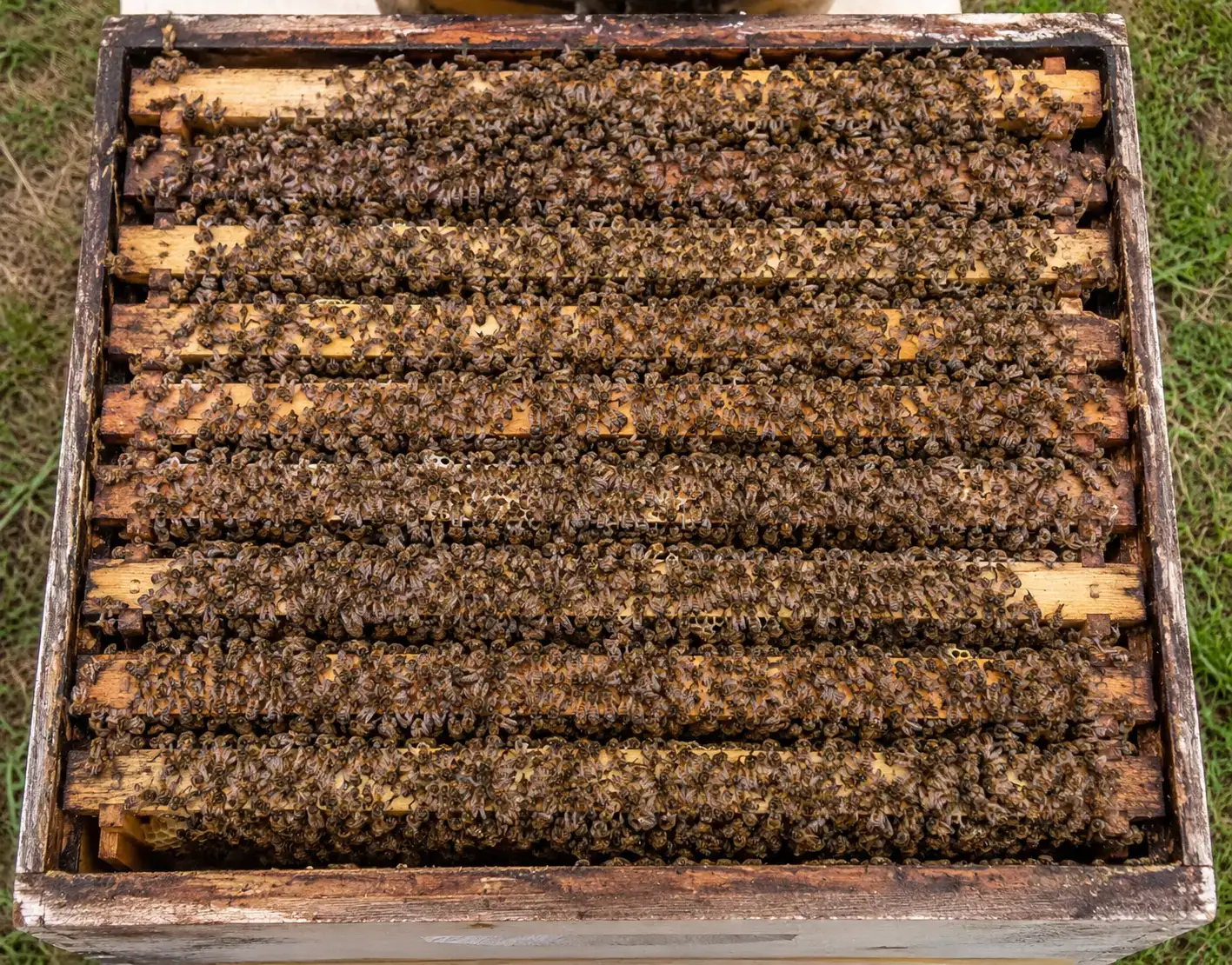
A colony with a lot of brood and few occupying bees should be critically looked at. Brood and bee mass must match. (Critical phase during the transition)
3. Take Winter Bees Seriously
Winter bees are the best test for worker longevity. They must live long and still be productive in spring. The foundation for the next year is laid already in July!
4. Ensure Pollen Supply
Without good protein supply, no high-quality workers arise. Young bees especially need pollen for their fat body, hypopharyngeal glands, and immune system.
5. Keep Varroa Low Early
Long-lived workers do not develop under high varroa pressure. Especially winter bees must be reared healthily. The main rule is: Varroa must be low before winter bees develop.
6. Manage Thermal Regulation Appropriately
A colony should be able to warm its brood efficiently. An adjusted brood chamber helps prevent unnecessary wear on workers.
7. Don’t Manage for Wear
Long-lived workers arise more where the colony remains balanced: appropriate brood amount, enough nurse bees, good pollen supply, low varroa pressure, stable thermal regulation, and little stress.
How to Identify Long-Lived Workers in Practice
Longevity is not seen at a single inspection. It’s recognized over time.
What’s important is: It’s not about whether a colony looks particularly strong on one day. It’s about whether its workers remain vital, productive, and resilient over weeks.
The Biggest Misconception
The biggest misconception is equating brood area with colony quality.
A lot of brood can be a good sign. But it can also be a warning signal if the colony cannot translate this brood into stable worker mass.
A colony that constantly needs a lot of brood to replace losses is not automatically productive. It might just be undergoing significant wear.
A truly good colony is characterized by the fact that appropriate brood leads to long-lived, vital, and productive workers.
Sample Calculation: Same Brood Amount, but Different Lifespan
Assumption:
- Start in spring: 25,000 workers
- daily emergence: 1,200 young workers
- brood amount remains constant in both colonies
- difference only: workers live on average 25 days or 35 days
Time
Ø 25 Days Lifespan
Ø 35 Days Lifespan
Difference
Start
25,000
25,000
0
after 1 week
approx. 26,200
approx. 28,100
+1,900
after 2 weeks
approx. 27,200
approx. 30,700
+3,500
after 3 weeks
approx. 27,900
approx. 32,800
+4,900
after 4 weeks
approx. 28,400
approx. 34,400
+6,000
after 5 weeks
approx. 28,800
approx. 35,800
+7,000
after 6 weeks
approx. 29,100
approx. 37,000
+7,900
Importance for Early Forage
With 25 days lifespan, the colony grows slightly, but a large part of the daily emerging bees only replaces losses. The colony barely grows beyond the initial strength.
With 35 days lifespan, the workers remain noticeably longer within the colony. As a result, much more bee mass accumulates from the same brood amount. After six weeks, almost 8,000 more workers are available, and the forage performance increases significantly.
Significance of the Sample Calculation
This calculation is deliberately simplified. In a real bee colony, the brood amount does not remain constant in spring. With increasing colony strength, better pollen supply, rising temperatures, and stronger laying performance of the queen, the brood area usually increases further during spring development. Therefore, the actual end numbers would develop differently in practice.
The example is not intended to provide an exact colony prognosis. It only illustrates the fundamental relationship: With the same initial brood performance, a colony with longer-lived workers develops significantly stronger because fewer bees are lost to early death.
Conclusion
A lot of brood alone is not enough. What matters is whether workers emerge from this brood that remain healthy long enough to nurse brood, retain heat, process nectar, forage, and carry the colony stably through periods of stress.
The fat body plays a central role in this. It is the internal reserve of the worker and particularly important for winter bees. Without a good fat body, sufficient protein provision, and low varroa and virus pressure, truly long-lived workers do not arise.
Thermal regulation is also part of it. A well-managed brood chamber with a sensibly placed divider can help bees efficiently warm and care for their brood without unnecessarily wasting energy. Too much space can be burdensome; too little space can be restrictive. The key is the adaptation to the actual bee mass.
The central rule is:
Not the largest brood area makes the best colony, but the best translation of brood into long-lived, healthy, and productive workers.
Test bee-pilot.io now