Trachtless Period
Robbing in Bees
Why Splits and Mating Units are Particularly Vulnerable
When nectar flow declines, the behavior of many bee colonies changes significantly. Especially after the summer nectar flow, during extended dry periods, or in a dearth, foraging bees intensely search for any available food source.
During this period, the risk of robbing increases significantly. Bees from one or more colonies invade another colony to steal honey or stored food. What might initially look like normal flight activity can quickly develop into a serious threat.
Which Units are Particularly at Risk?
Small or weakened units often cannot fend off robbing for long. Therefore, special caution is needed during nectar dearths.
Why Does Robbing Occur?
In a good nectar flow, bees find nectar, honeydew, and pollen in nature. When this supply diminishes, many foragers seek other food sources.
They react very strongly to the smells of honey, sugar syrup, fondant, extracted combs, or open feeding devices.
When a bee finds such a source, this information is communicated within the colony. As a result, many robbing bees can appear in a short time.
What Happens in the Affected Colony?
A strong colony can usually defend its entrance well. Guard bees control incoming bees and drive away intruders.
With small splits or mating units, the situation is different. They have only a few bees. Defense at the entrance is weaker, and often the queen is either unmated or has just begun laying eggs.
When robber bees invade, stress spreads throughout the colony. There are fights at the entrance and inside the hive. Bees are injured or killed, and food stores are emptied.
In small units, the queen may be lost, or the colony may collapse entirely.
Why are Mating Units Particularly Vulnerable?
Mating units are small and have only a limited number of bees. They often have minimal food reserves and can hardly defend themselves against strong robbing bees.
Additionally, many mating units are created during times when the main nectar flow is already dwindling or over. This is precisely when the threat from searching bees increases.
Mating units should, therefore, be opened and inspected with great caution during nectar dearths.
Why are Newly Created Splits Particularly Vulnerable?
Newly created splits do not yet have full colony strength. They must first organize, build new foragers, and secure their entrance.
Many splits also have a high food demand. When they are fed, a strong scent quickly arises, attracting robbing bees. Liquid food is particularly critical when it drips or is openly accessible.
Principle: A small colony does not need a large entrance. The smaller the unit, the smaller the entrance should be.
How to Recognize Robbing
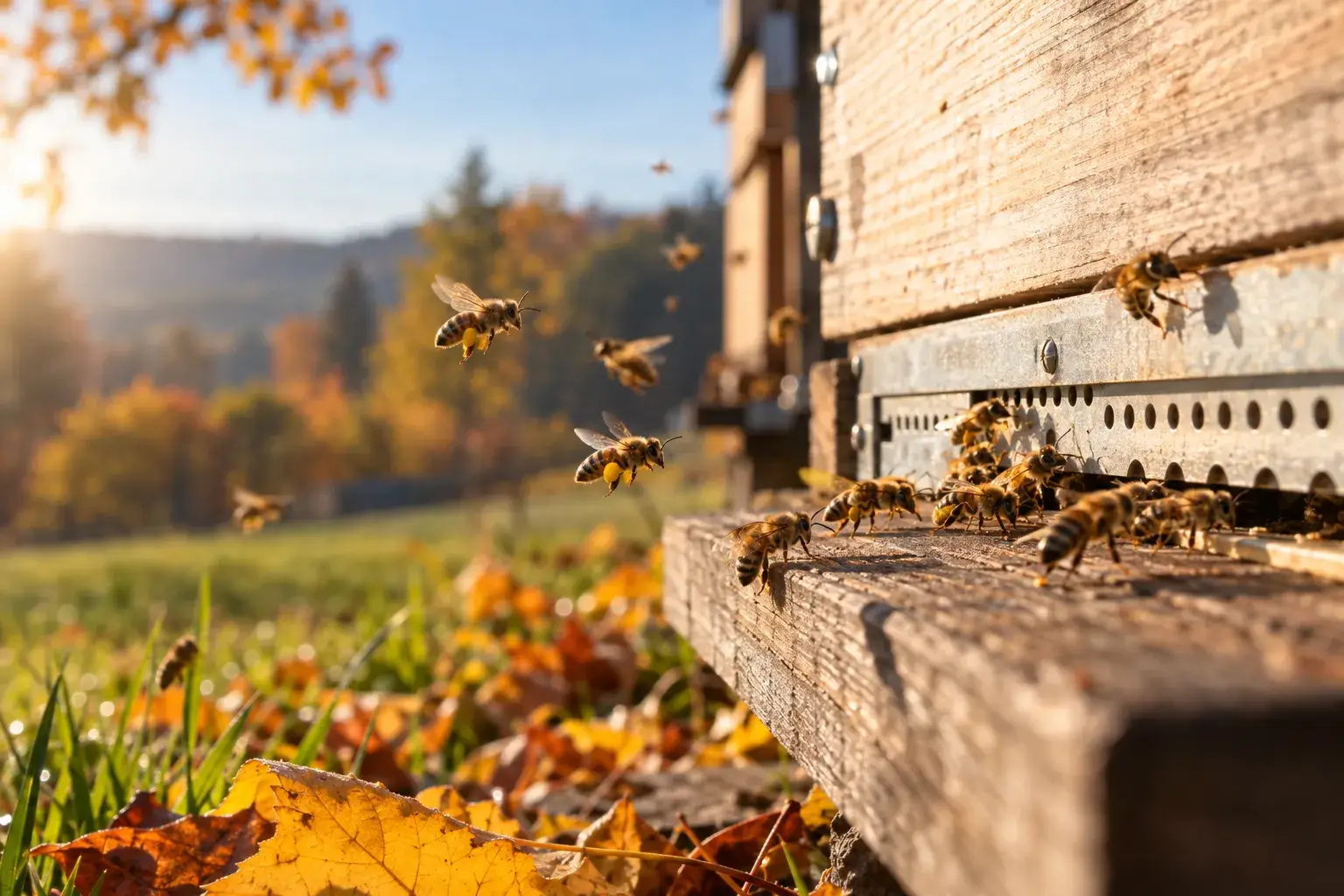
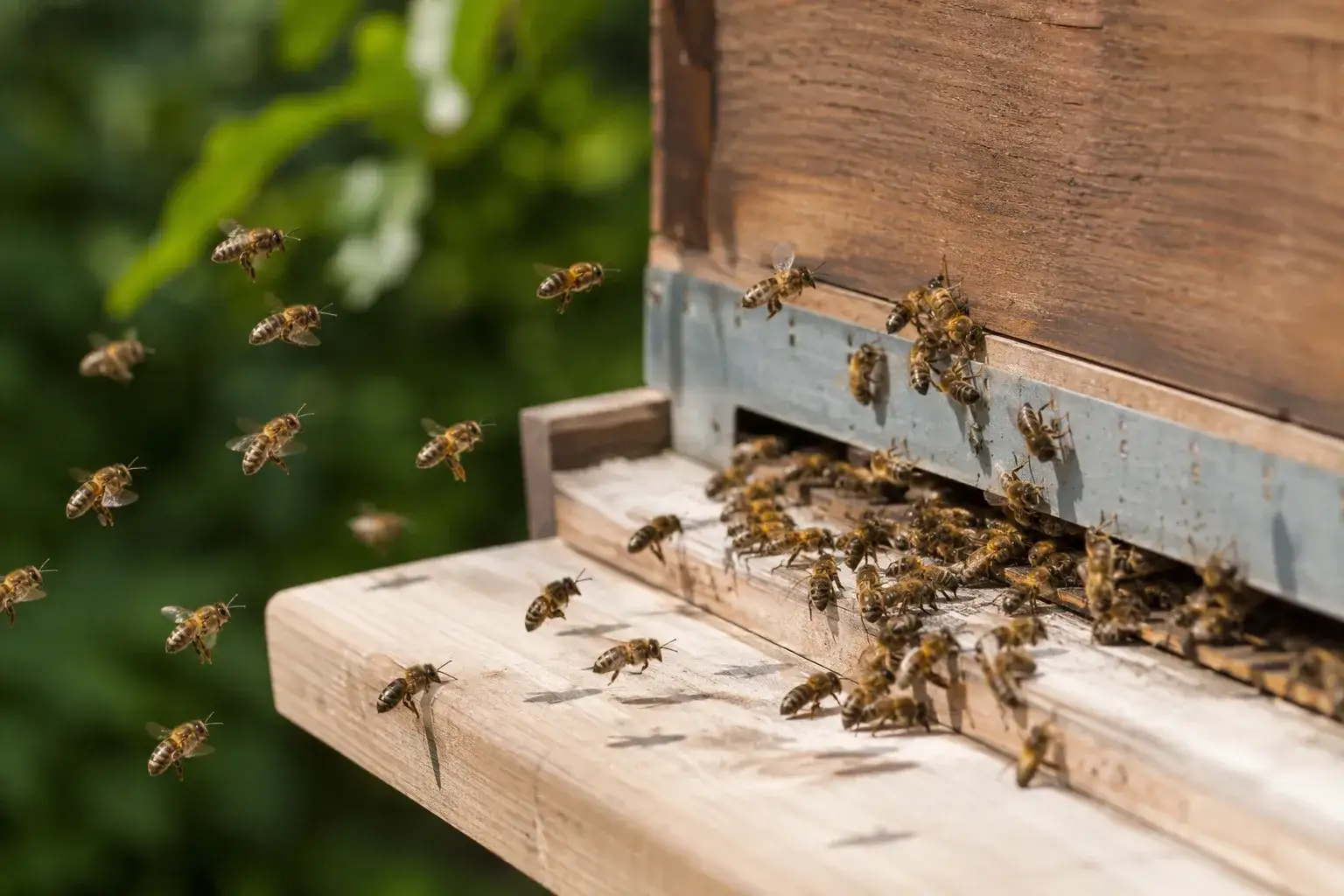
Robbing is often detected by hectic, restless flight activity. Instead of calmly flying in and out, bees search the hive front, crevices, the lid, or the back for ways to enter.
It’s important to distinguish this from orientation flights of young bees. When young bees orient themselves, many bees are often seen in front of the hive, but they usually fly more calmly in arcs around the entrance. In contrast, robbing appears hectic, aggressive, and uncontrolled.
Immediate Measures Against Robbing
When robbing begins, immediate action is necessary. The earlier intervention occurs, the better the chances.
The most important measure is the immediate narrowing of the entrance. For small splits or mating units, the entrance can be reduced to a very small opening.
It is crucial that the colony’s own bees can defend the entrance again.
In cases of severe robbing, it may be advisable to temporarily relocate the affected unit. Especially mating units or small splits can often be better protected at a quieter location outside the direct flight radius.
Preventive Measures
The best measure against robbing is prevention. Particularly small units should be managed very carefully during nectar dearths.
1. Keep Entrance Small
The entrance must match the colony strength. Small units need small entrances. With mating nucs and newly formed splits, the entrance should be small enough to be securely guarded.
Better to start too small than too large. As the unit strengthens, the entrance can be gradually widened later.
2. Feed in the Evening
Feeding should ideally take place in the evening when flight activity diminishes. This reduces the risk of scouting bees immediately discovering the food source.
3. Feed Cleanly
During feeding, nothing should spill. Dripping sugar syrup or open food remnants are strong triggers for robbing.
Especially with small splits and mating units, feeding should be done very cleanly and without spilling.
4. No Open Combs at the Apiary
Honey combs, food combs, or extracted combs should not be left open at the apiary. Even a short time can be enough to trigger robbing.
Combs should always be stored bee-tight or immediately closed again.
5. Do Not Unnecessarily Open Small Units Long
Splits and mating units should only be inspected briefly. Any prolonged opening spreads scent and makes the unit vulnerable.
Inspections should be well-prepared. Consider what needs checking, then open, inspect, and close immediately.
6. Critically Assess Weak Units
Very weak splits or mating units are particularly vulnerable during nectar dearths. If a unit is hardly defensible, it should be assessed whether merging is more sensible than continuing separately.
7. Maintain Distance from Strong Colonies
If many small mating units are directly next to strong production colonies, the robbing pressure can increase. A separate, quieter location for mating units can help.
8. Consider Fondant Instead of Liquid Food
With very small units, fondant can often be safer than liquid food because it generates less smell and doesn’t leak. However, even fondant must be given in such a way that no open food remnants attract robbers.
What Should be Avoided?
During nectar dearths, certain activities should be undertaken with extra caution or avoided entirely.
Even a small mistake can be enough to trigger robbing during a nectar dearth.
Conclusion
Robbing is a serious threat during nectar dearths. Small and weak units, such as newly created splits, mating units, MiniPlus colonies, or Apideas, are particularly affected.
Prevention and swift action are crucial. Keep entrances small, securely close food sources, and minimize hive interventions.
Those who work cleanly, protect small units, and recognize warning signs early can avoid many losses.
Test bee-pilot.io now