Swarming Season
When Colonies Are Constantly Preparing to Swarm …
Understanding, Evaluating, and Taking Targeted Action Without Losing the Harvest
Swarming is natural for a bee colony. For the bees, it’s not a problem, but the normal way of reproduction. This is where the conflict of interest for the beekeeper lies: During the honey flow, a swarm often results in a significant loss of foraging strength, and thus less honey.
It’s not about suppressing the swarming instinct completely but rather about controlling the timing. Colonies should work during the main honey flow and not swarm.
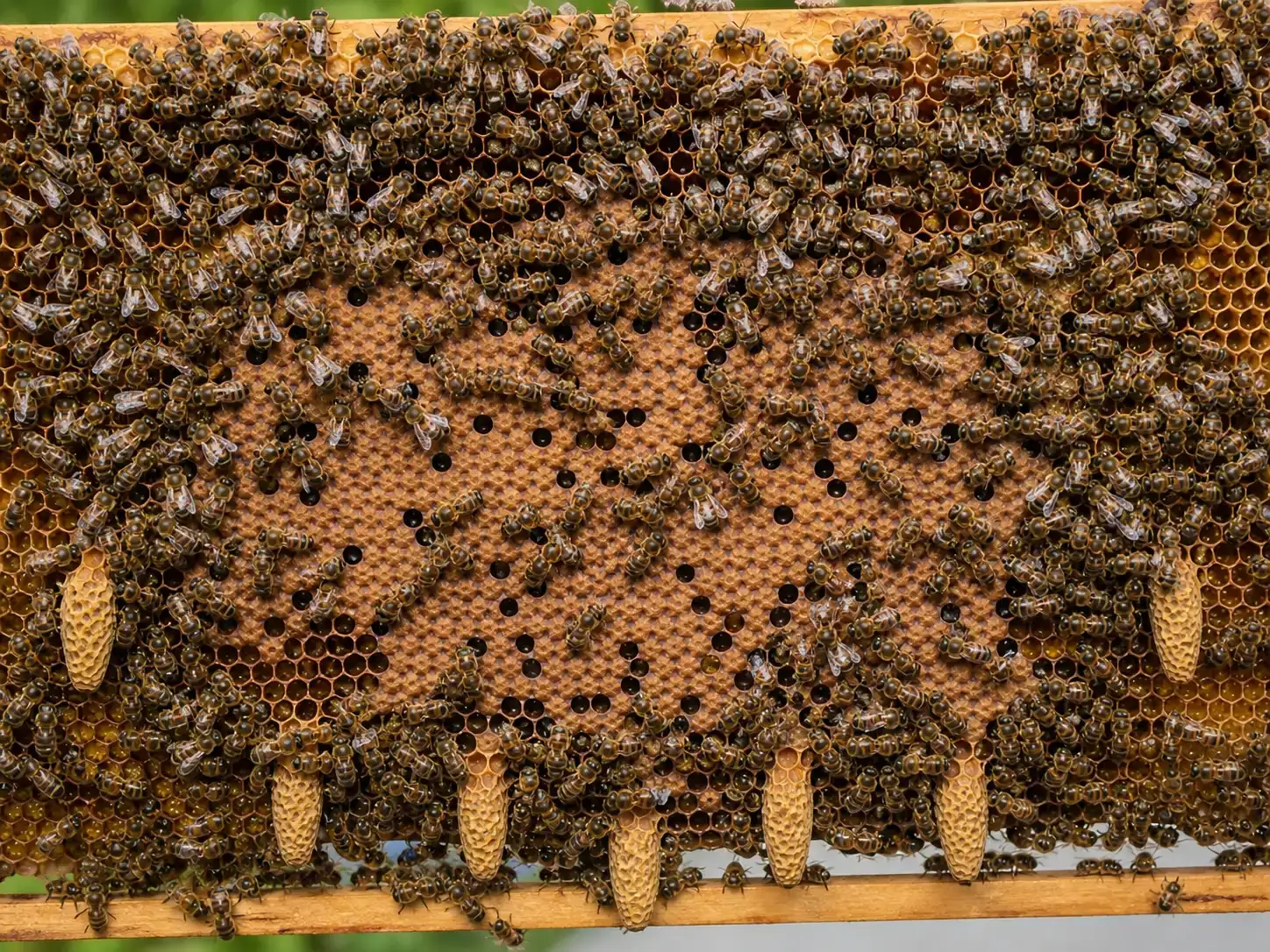
The challenge arises when a colony remains perpetually in swarming mode. Typically, new queen cells are found at each inspection, even though everything seems to be in order: there’s space, honey supers are added, and the colony is strong.
In such cases, simply applying individual measures is no longer sufficient. One must systematically understand the causes and intervene deliberately if necessary.
Why a Colony Remains in Swarming Mode
The first step is always understanding why the colony remains in this state. Typically, it’s a combination of factors rather than a single cause.
Often, the bee population is very high, while the usable space is not optimally distributed. There can be bottlenecks in the brood area, such as heavily occupied pollen frames or honey-bound sections.
At the same time, the honey storage might not have been expanded quickly enough, leading to backlog. This is often accompanied by a surplus of young bees without sufficient tasks.
And lastly, the queen plays a role, both her age and the genetic predisposition of the colony.
As long as these factors persist, swarming tendency will keep returning. This is why merely destroying queen cells is not a sustainable solution. It only postpones the problem.
Truly Changing Swarm Pressure in the Colony
The first step is always to alter the situation in the colony, so there is no persistent swarm pressure. It’s less about providing as much space as possible and more about organizing the brood area coherently.
A brood nest functions best when it remains contiguous and bees can work without obstructions. Too much space or a stretched out brood nest can be as problematic as too little space.
Recognizing Pollen and Honey Blockages
An important point is pollen and honey blockages. Heavily occupied pollen frames can constrict the brood nest without being immediately noticeable.
In such cases, it may be helpful to intentionally replace individual frames with foundation to reintroduce movement into the system. The same goes for honey-bound areas in the brood nest, which should also be loosened.
The Honey Chamber is Often More Crucial Than the Brood Chamber
The honey chamber is just as crucial. In practice, the cause of swarm pressure often lies not in the brood chamber but above it.
If nectar is being brought in but there’s not enough space to process and dry it quickly enough, it leads to a backlog. This indirectly impacts the brood nest and significantly increases swarm pressure.
Therefore, it’s important not to expand honey storage only when it’s full, but early and proactively.
Principle: Don’t add to the honey chamber based on feeling, but according to nectar flow, colony strength, and actual capacity.
Young Bees Need Employment
Another point is keeping the bees busy. An excess of young bees without tasks substantially increases swarm tendency.
By purposely providing foundation or encouraging construction activity, this energy can be effectively utilized. Bees get busy, shifting focus from swarm preparation to work.
Creating Splits: Effective but With Consequences
Creating splits is also an effective method to reduce swarm pressure. However, it has a clear downside: Every bee removed is one less for the honey flow.
This means foraging performance decreases. Those targeting honey yield should use this measure consciously and more sparingly.
Don’t Forget the Queen
If a colony continually goes into swarm mode despite corrections, take a closer look at the queen. Some lines are more prone to swarming than others.
The age of the queen also plays a role. In such cases, targeted queen replacement is often the most sustainable solution.
When Corrections Are No Longer Enough
Sometimes the cause cannot be clearly identified, or the swarming tendency persists despite all measures.
At that point, it’s not just about corrections, but about assuredly preventing the actual swarm from issuing.
It’s crucial that foraging performance is minimally affected. This means the flying bees should remain on site and continue to work.
Snelgrove Board: Interrupt Swarming Instinct, Maintain Foraging Performance
A very proven method is the Snelgrove board. The colony is split into two units within the hive.
Part of the brood is moved up with the attending bees, and a Snelgrove board with its own entrance is inserted behind. Below, the queen remains with the flying bees.
These continue to forage, while a second part of the colony forms above. This separation interrupts the swarming instinct while largely maintaining foraging performance since the flying bees are not lost.
Creating a Split: Strong Against Swarm Pressure
A similar goal is achieved by creating splits, albeit with a different implementation.
Here, the brood colony is moved to a new location while a new unit with the queen is established at the original location. The flying bees automatically return to their original site and reinforce this unit.
This creates a very strong foraging colony, while the separate brood unit develops on its own. Again, the swarming instinct is reliably broken without losing foraging performance—in fact, it may even temporarily increase.
Restructuring the Brood Nest
Less invasive yet still effective is the deliberate restructuring of the brood nest. Instead of reducing the bee population, the arrangement is changed.
Capped brood can be moved up while space is created in the brood area, perhaps with foundation. This disrupts the typical structure leading to swarming tendency. (Do not move drones as they cannot pass through the queen excluder.)
Nurse bees redistribute, and the swarming instinct is interrupted. The big advantage of this method is that the entire bee population remains in the colony, so there’s no loss in foraging performance.
The Advantage: The bees remain in the colony, but the internal order is changed to interrupt the swarm impulse.
Controlled Use of Swarming Tendency
Another possibility is to use the existing swarm tendency in a controlled manner instead of completely suppressing it.
Selective queen cells are left, and the rest are removed. The old queen remains in the colony, and the situation is closely monitored.
In some cases, a small quantity of brood can additionally be removed without noticeably weakening the colony. This method requires experience and precise work but can significantly reduce swarm pressure without notably affecting foraging performance.
Important: This method is only suitable with regular and precise monitoring. Without monitoring, the swarm risk increases significantly.
Conclusion
Ultimately, there is no single standard solution. The key is always the combination of understanding and targeted action.
First, the causes should be corrected as much as possible. If that’s not enough, clear measures must follow to prevent the swarm issue without destroying the colony’s performance.
The central thought is simple: Successful swarm prevention does not mean intervening strongly but working such that the bees can remain in honey flow.
Those who manage to keep the bee population in the colony while interrupting the swarm drive use the season much better—and ultimately work in harmony with the bees’ natural behavior, just at the right time.
Finally, a brief but important thought:
Some of these measures seem tough at first glance. That’s because the beekeeper actively intervenes in the colony’s structure. However, it doesn’t mean that a swarm is something “bad”—on the contrary, it’s a completely natural and meaningful process.
The difference lies in the interaction between beekeeper, bees, and nectar flow. The beekeeper takes a guiding role: shifting certain timings or preventing the swarm during a phase where the colony can effectively channel its strength into the honey flow. It’s not about working against the bees but about consciously steering at the right moment.
It becomes animal-friendly because the colony remains stable, productive, and healthy. The interventions aren’t ends in themselves but serve to prevent extreme situations and establish a balance between natural behavior and utilization by the beekeeper.
Try bee-pilot.io now