Wabenlagerung
Storing Honeycombs After the Last Extraction
How We Safely Keep Our Combs Through the Winter
The last honey harvest may mark the end of the extraction season, but the work isn’t over yet. There’s one question every beekeeper faces each year:
How do I store my honeycombs properly over winter?
Every apiary is different, and each method has its pros and cons. The key is to keep the combs dry, clean, and free of wax moths until spring.
We want to introduce you to the most common methods and explain what we focus on at Bee Pilot.
Store Honey-Moist or Allow Cleaning?
This question has been debated among beekeepers for years.
From our view, there’s no right or wrong here.
Store Honey-Moist
Many beekeepers store their honeycombs directly after extraction. Small residual honey remains in the cells.
We generally see no problem with this.
Allow Cleaning
You can also replace the honey supers on the colonies and let the bees remove the remaining honey.
This method also works well.
Our Opinion: We do not consider either method fundamentally better. Both work if the combs are subsequently stored correctly.
The Real Key Lies in Storage
Whether the combs are honey-moist or cleaned out does not determine success.
What matters more is protecting the combs from wax moths, mice, and moisture.
Method 1: Store Cool and Airy
This method has been successfully used for decades.
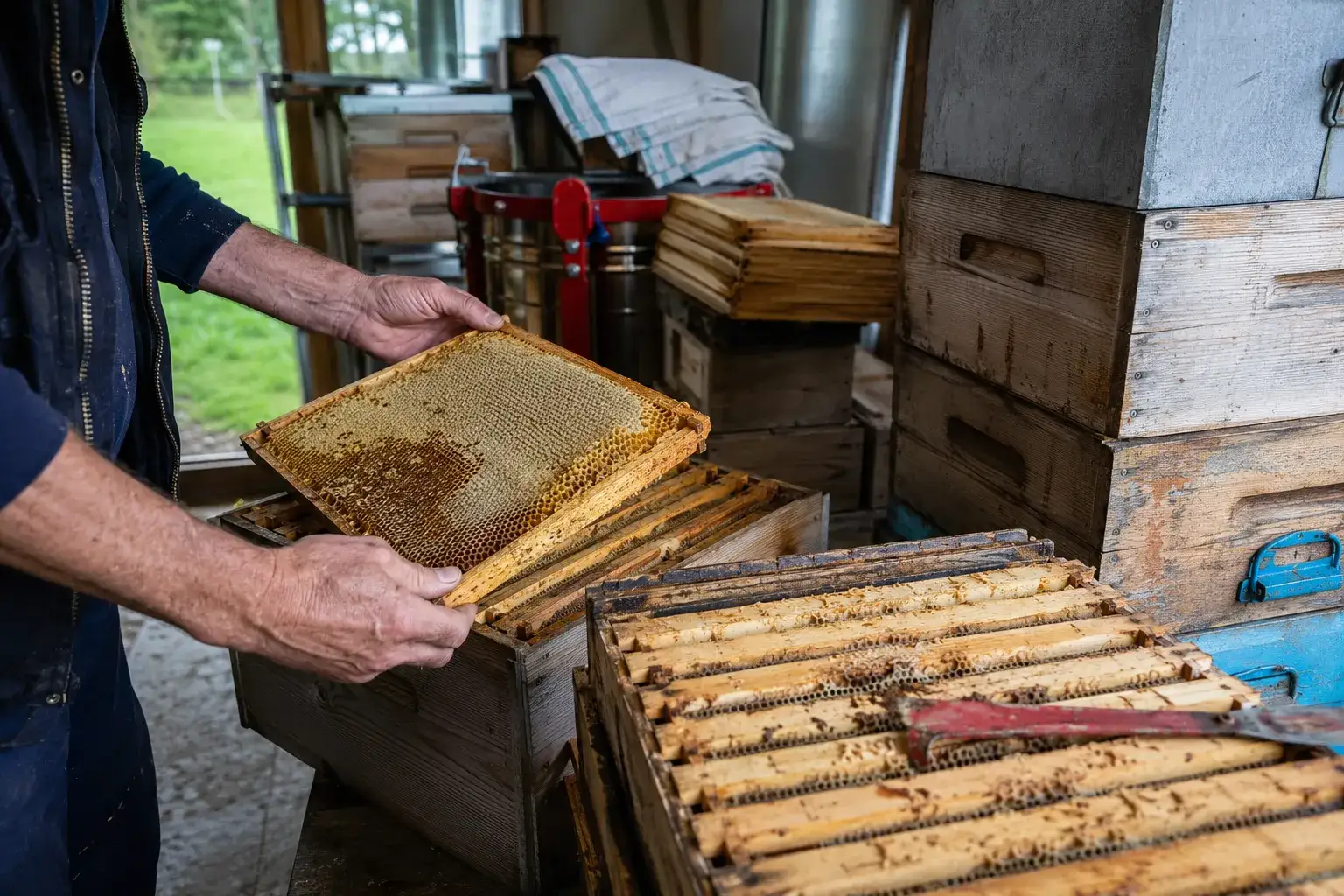
Honey supers are stacked and closed at the top and bottom with fine mesh. Air circulation creates an unfavorable climate for wax moths.
Method 2: Freeze Combs
In our view, this is one of the safest methods.
The combs are frozen for at least 24 to 48 hours, killing any wax moth eggs and larvae.
Combs should thereafter be stored as moth-proof as possible.
Method 3: Store Airtight
Many beekeepers use sturdy plastic bags, tightly sealing boxes, or special comb cabinets.
It’s important to store the combs dry.
In our view, this method works particularly well when combined with prior freezing.
Method 4: Cold Storage
Having a cold storage room offers ideal conditions.
The low temperatures largely prevent wax moth development.
Method 5: Acetic Acid
Some beekeepers treat their stored combs with acetic acid.
The fumes can affect various stages of wax moth development.
Method 6: Formic Acid
Formic acid is also sometimes used to treat stored combs.
Method 7: Sulfuring
In the past, sulfuring was almost standard.
Some beekeepers still rely on it today.
Method 8: Bacillus thuringiensis
This is a biological method.
Combs are treated with an appropriate preparation. Young wax moth larvae die when feeding on the treated combs.
Better to Melt Down Old Combs
We believe winter is also the right time to critically review the comb stock.
We recommend sorting out the following combs:
- Very dark brood combs
- Damaged combs
- Moldy combs
- Combs with wax moth infestation
- Old combs with lots of pollen
A clean wax cycle is often more important in the long term than preserving any single comb.
Overwintering Black Combs, Use Special Caution
Black brood combs have a bad reputation among many beekeepers. However, it’s important to note: Dark or even black combs are not automatically unhygienic or bad for the bee colony. On the contrary, bees often accept them very well, and they are especially suitable in the brood chamber.
However, the problem arises with storage over winter.
Black brood combs contain many cocoon remnants and often pollen residues, making them much more attractive to wax moths than light honeycombs, thus posing a much higher infestation risk.
From our perspective at Bee Pilot, black combs should not be stored unprotected. A very reliable storage method, such as freezing the combs for 24 to 48 hours followed by moth-proof storage or alternatively permanent storage in a sufficiently cool cold room, has proven effective. This greatly reduces the risk of wax moth infestation.
Our Recommendation from Bee Pilot
In our view, there’s no one perfect method.
For smaller apiaries, we prefer freezing with subsequent moth-proof storage. This method is very reliable and uses no chemicals.
In larger apiaries, dry, cool, and well-ventilated storage has often proven successful. Key factors are regular checks and a dry storage room.
Whether combs are stored cleanly or honey-moist plays a much smaller role for us than proper storage throughout the winter.
Important Note
For some methods, like using acetic acid, formic acid, sulfur, or biological preparations, different legal regulations apply depending on the country. Always check applicable laws in your country before application and use only approved products according to manufacturer’s instructions.
Conclusion
The storage of honeycombs often determines how usable the comb material is in the next spring.
Those who store their combs dry, check regularly, and protect reliably against wax moths, mice, and moisture, will be rewarded in the spring with clean and ready-to-use honeycombs.
As is often the case in beekeeping, several paths lead to the goal. What matters is not which method you choose, but that it is implemented consistently and carefully.
Easily document observations and work at the bee stand